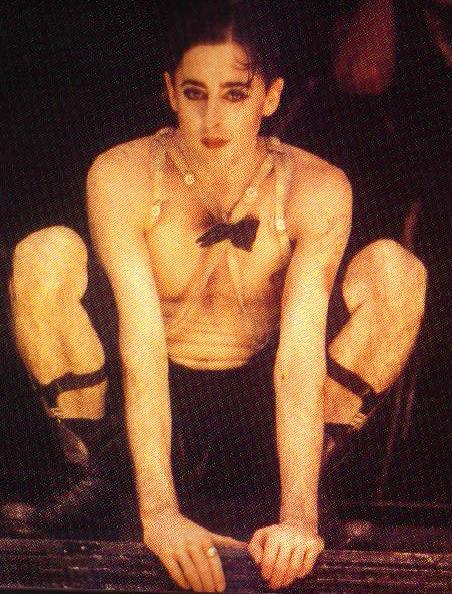
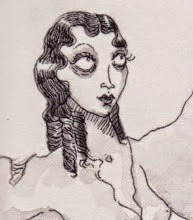
So I'm posting this! I would like to give myself a big pat on the back for having the bravery to post something in which I look this hideous. When I come down from the sick (which is likely adversely affecting my judgment), I will probably regret this very, very much.
But, thanks to all my delightful facebook friends for all their wonderful suggestions for what I should watch while home sick! This is dedicated to all of you.
Showing posts with label apocalypse. Show all posts
Showing posts with label apocalypse. Show all posts
Saturday, December 4, 2010


Tuesday, November 23, 2010
Apocalypse Girls: Mockingjay
 Recently, a friend's 8th grade daughter levied her criticism on the first Hunger Games book thusly (to paraphrase): "If it's going to be sci-fi, it should be good sci-fi." , and then went and buried her head back in Crime and Punishment.
Clearly, my taste is far less discerning as I liked both the first and second installments in the series (for some background, take a look at my previous posts). I thought the second book was particularly wonderful, with its intelligent and heartbreaking depiction of how the powerless and disgruntled fare in a totalitarian regime (hint: not well). I was also taken with the heroine, Katniss Everdeen, and the way in which Collins has her functioning in her increasingly complicated and distressing circumstances in the post-apocalyptic country of Panem (obviously the remains of the United States). She's someone who has never had the opportunity to be a child: she's been looking after her family since she was little, and has all the attendant anxiety and guilt that level of early responsibility brings. She's not a hero because she's decreed as special by some outside agency (see: Harry Potter, the abysmal Alchemyst books, Star Wars, even my beloved Buffy), she's not "The One". She's thrown into the voracious media spotlight of her society through lottery, and becomes a media darling because of her own tenacity to survive and through exhibiting an unusual integrity during the Hunger Games in book one. She becomes in the second book, Catching Fire, the symbol of dissent, something she never asked for and finds dangerous as it places her family and district in jeopardy as the iron fist of the state comes crashing down on them. This is wonderful, potent stuff.
As the third book, Mockingjay, opens, the poor districts of Panem are in open rebellion against the wealthy Capital. Katness is in hiding with the leaders of the rebellion in the previously thought destroyed and empty 13th District. In actuality, the rebels of the 13th are allowed to survive because they are locked in a nuclear detente with the Capital. The leaders of the rebel forces know Katniss is a potent symbol and use her celebrity to propagandize their cause. One thing that I absolutely adore about these books is the moral complexity in terms of the politics. The rebel forces are terrifying, in their own way, as much as the decadent, slave based government in the capital. The rebellion has been fomenting for years, they know they have right on their side, they are puritanical and martial, and they don't brook much in the way of dissent. In other words, the Czar is awful, and the Bolsheviks aren't necessarily better. Which is interesting, but makes for an increasingly unpleasant read.
Most distressing to me, is the change in Katniss's status. Now Katniss had become "The One". In some ways this feels like an artificial structure built to insure that Collins's heroine remains front and center. A slightly ridiculous amount of the rebel's strategy seems built around the existence of Katniss Everdeen in a way that felt slightly contrived. The best use of Katniss's new status was the creation of a pirate television series featuring Katniss amongst the rebel forces. It's pure propaganda, of course, Katniss is too valuable to the cause to put in real danger. She is quickly airlifted in and out of hot spots accompanied by a full camera crew. But later in the book the Katniss focus felt as corrupt as the Capitol itself. One of the terms of Katniss's cooperation with the rebellion was that she got to kill President Snow herself. In order to assure this, many, many other people die.
The carnage by the end of the series is fairly epic. I know I'm a total wimp, but by the end I began to feel just bludgeoned and manipulated, which, to be fair, might have been the point. I finished the book a while ago, but I've been sitting on this review as I honestly wasn't sure of what I thought. As with the first two books, I read Mockingjay in one sitting - Collins, if nothing else certainly knows how to tell a story, and putting aside what I said in my review of the first book, she pulls very few punches. The society she's invented is terrifying. It's a combination of the worst aspects of Russia under the Czar, with the rich living lives of unbelievable decadence with the majority in the districts living lives of absolute brutal poverty. Combine that with our current age of reality television and media spin, and you have a really ugly brew of an imagined but seemingly possible future.
Thursday, November 11, 2010
Michael Kors Is Fucking Dead To Me and I'm Breaking Up With Project Runway: An Email in Six Fits
 Dear Project Runway,
I've had a solid two weeks (Yikes!) to think about it, sufficient cooling down time to be certain that this relationship is over. Done. You have broken my heart for the last time. And most heinously, you have once again reduced this blogger to the indignity of the listicle. Below are my reasons for severing all ties.
1. I bemoaned the loss of the Magical Elves as producers when PR made the jump from Bravo to Lifetime. I suffered through the disaster that was the Los Angeles season and the boredom and pointlessness that ensued. I perked up slightly (but only slightly) when PR moved back to NYC, and Seth Aaron won. I have written before about how I don't really believe in Shark Jumping, but when the Season 8 winner was announced last week, and after listening to the judges' deliberation, I completely lost patience and interest in anything the current producers of the show are foisting on us: Tim or no Tim, Heidi or no Heidi.
2. I found Gretchen, the personality, kind of fascinating [a], albeit not in a good way. However, I found Gretchen, the designer, dull beyond imagining [b].
a. Gretchen stands as the single most unlikable reality show contestant I have ever seen. Obviously, this is an utterly subjective statement. Most unpleasant, mean or not-nice reality characters from Jeffrey Sebelia to those tramps that shriek at each other on Rock of Love to those mean and over-competitive douches on The Amazing Race, all seem like they are in some way tailoring what they say and do for the cameras. Some (like Jeffrey) have admitted that they knew this perception of themselves would make good television, so they played it up. Some of these people are just unbelievably stupid and/or very, very drunk (see Rock of Love). I've seen some express remorse after seeing themselves on TV, and realizing how awful they look. Gretchen is nothing like any of these people. She's truly awful in the way that people in actual real life are awful. The cameras, the competition, the structure of the show: none of these things seemingly have any bearing or effect on the wretchedness of the horrible Gretchen. She's narcissistic to a mind-boggling degree. When Mondo very movingly revealed his HIV positive status, her reaction was all about how great it was that she was there for it. She's the sort of blank faced, undermining bully who shrouds her cruelty in offers to "help". She has no compunction when she doesn't do well, to blame others, cry, and distance herself from the disaster, even if the disaster was entirely of her making (see: Team Luxe and the shameful behavior towards Michael C.). She's the sort of bully that is clever enough to get minions to do her dirty work (see: Ivy). She's an awful person and I almost vomited during the reunion when she cried about how America thought she was a bitch because she's a strong woman. I'm sorry Gretchen: America thinks you're a bitch because you are a terrible human being. Then there was her seeming view that showing up for the challenges (i.e. the whole point of the show) was somehow beneath her, and that this season was some sort of victory lap in which she really didn't have to try. When she said to Heidi, "I'm tired of the challenges. I just want to make my clothes.", during the judging of a challenge in which the parameters were so wide she could do just that (i.e. find inspiration anywhere in NYC. Make an outfit. This was too limiting for Gretchen, I suppose, who turned out something hideous.). By the end, Heidi clearly couldn't stand her, calling her arrogant. And then, bafflingly, she took the whole thing. See the pathetic, embarrassing damage control video Marie Clare has foisted on the word (and if there's one thing we've learned in the past week or so, it's that Marie Clare sucks at damage control). I warn you, the video is heinous and really hard to watch.
b. But, you say, this is a design competition, not a personality contest! What about the clothes? Sigh. I can say, with great confidence, that absolutely no one has been waiting for the day when earth-toned knit hot pants become available. And, in her final runway presentation, there wasn't just one pair of earth-toned knit hot pants, there were three. Before presenting their final collection each of the finalists is required to introduce themselves and their work, briefly saying something about what they have chosen to present. Both Mondo and Andy (the other two finalists) spoke briefly about their influences: their ethnic heritage, where they grew up, and very nicely thanked their parents, grandparents, etc. Gretchen simply told us she named her collection "Running Through Thunder" and was happy her Mom was there, but the clothes looked like Rolling in Baby Poop:
3. So, what about the competition? Who came in second? In a stroke of Reality TV brilliance, Horrible Gretchen was pitted against Mondo, one of the most delightful personalities in the history of reality competition shows [a], and his creativity and designs were consistently thrilling [b].
a. Mondo may be the anti-Gretchen. He seems so lovely and interesting in precisely not the way people on reality television are supposed to be. He's a tiny, shy, intense, deeply strange, Mexican American designer from Denver. Early in the season, he struggled a bit and wound up on the bottom a few times. The turning point of the season was Episode 5, where all the underdogs (including Mondo) wound up on one team, and trounced the team of previous winners led by Gretchen (the previously alluded to Team Luxe disaster). In the subsequent episode, the designers were placed in teams of two, Mondo was teamed with the cruelly bullied Michael C. In the beginning of the episode, Mondo was not pleased. He had heard from Michael C's awful teammates that he couldn't sew and was completely hopeless in every way. So, Mondo was worried about working with him, and was maybe not as nice as he could have been. But Mondo quickly realized that there was nothing wrong with Michael C., that he was hard working and nice, so Mondo apologized for his behavior (which really wasn't that awful). His apology impressed me because it seemed genuine and he didn't make a big fuss or congratulate himself or weep. He just told Michael, "I was being a jerk. I'm sorry. I was wrong." Mondo is such an odd little duck. He dresses flamboyantly (clearly basing many of his fashion choices on the Donmar Warehouse version of the Emcee in Cabaret), but his personality is not. He's quiet, intense, and a very skilled and smart perfectionist. I also love that in a flamboyant industry, working in a room filled with gay artistic types, Mondo is still a total fucking weirdo, and I say that with nothing but love and adoration.
b.This is where things start getting really freaking obvious to me. Mondo is a real find. His talent truly became apparent in the Jackie Kennedy challenge. He managed to hit that difficult to find Project Runway sweet spot: i.e. embracing the challenge fully, while not losing one’s own vision and aesthetic. This is incredibly difficult to do, and cannot be done consistently unless one both has confidence in one’s own voice, and the technical chops to realize it. His interpretation of the challenge was thoughtful and whimsical.

From that point on, Mondo started winning challenge after challenge. His clothes are beautifully constructed and tailored, combining colors and prints in riotous and exciting combinations that work and don’t look much like anyone else’s. I loved Mondo’s runway show. He utilized a Dia de los Muertos theme to great effect and I would possibly commit crimes to acquire some of his pieces (the leggings! I could die!).
4. Out of the eight seasons of Runway, there have been two winners and maybe one or two finalists whose work is truly special. Season 1 winner, Jay McCarroll, who may be the only winner in the history of reality television that after making lots of noise about wanting to work outside of corporate America, actually turned down the money rather than compromise his ideals and accept the strings that came with the 100k. It's nice to see that he's finally getting his act together and is showing, because he is very gifted. And Christian Siriano, who I found to be a little personally insufferable with his exaggerated bitchy manner and catch phrases, is really, really talented. He continuously demonstrated, that in this forum, technique counts. He was the first to admit that he had a huge leg up on the competition because he was able to sew very, very quickly. He was able to construct lovely, imaginative and complicated clothing in the time allowed for challenges, thus enabling him to make some extraordinary pieces. I really believe in technique in all art forms, it frees you up to do whatever you want to do, and Siriano was a great example of that. And then there were the winners that are, you know, fine, but not so super thrilling. Chloe Dao, Leanne and Seth Aaron seem to fall into that category. The previously mentioned Jeffrey had that one dress in his final collection that everyone remembers and was madly in love with. In other words, the judges over all did an okay job. I didn't always 100% agree, but their decisions were understandable. For example, the year Chloe won, I didn't think she was the most talented, but Santino and Daniel Vosovic both kind of choked. Which brings us back to this year's judging.
5. This is where they completely alienated me (and every other fucking person in the world seemingly). The three regular judges (Heidi Klum, Michael Kors and Nina Garcia) were joined by guest judge Jessica Simpson (who was far more articulate than expected). The four were divided evenly down the middle. Heidi and JSimp were in the pro-Mondo camp while Kors and Garcia (inexplicably) voted for Gretchen. What we saw of the deliberation was appalling. Michael Kors has lost every shred of credibility. He kept insisting the Gretchen was very "now" because hers were the sorts of clothing one is seeing in department stores. I mean, what the fucking fuck? Doesn't that mean, her stuff is, like, behind the curve? Also pointed out by JSimp and Heidi: if you're not 5'10" and dead skinny, Gretchen's clothes are unwearable. And am I wrong in thinking that when JSimp pointed out how all all of Gretchen's clothes are all so loose and baggy, the subtext was, "Um, I have boobs. Me and every other woman with boobs will look ludicrous and very, very pregnant in these hideous schmattas." And then they (Kors and Garcia) shut JSimp up by saying "read a magazine". Heidi at this point was basically raving, saying (I'm paraphrasing), "What is the point of this competition? Shouldn't we be rewarding creativity and innovation? Mondo's work is different and unique. What are you thinking? Gretchen's clothes need models and aggressive styling to look half way decent." For which I will love her forever. For going to bat for creativity and innovation in the face of Kors and Garcia literally sneering at her. And then Michael Kors intimated something that is truly outrageous. He said in response to Heidi's very valid points about rewarding talent, that there are designers in the world like John Galliano and there are designers in the world like, him, Michael Kors. He then intimated that the designers like Michael Kors are the ones to back, because more women wear their clothes. At which point my jaw simply dropped. If any of my non-fashion literate readers have made it this far, let me explain. Michael Kors is very talented. He makes nice, wearable, American sportswear. If you need a dress for your office party or some nice vacation wear, he's your man.
Which is fine, and yes, some version of what Michael Kors does is how most women dress day to day. John Galliano's spring men's collection was completely inspired by Charlie Chaplin. Below, is a lovely 40s inspired day dress (the model is styled to look exactly like Vivian Leigh). I decided to compare day dress to day dress, because if we were to get into evening wear, it would just be, um, unkind to Mr. Kors.

Michael Kors is talented. But, John Galliano is a stone cold genius, the likes of which come around at the rate of, say one or two every twenty five years. If we're lucky. It's kind of like if Dick Wolf said his work was more worthy of praise than Martin Scorcese's because more people watch Law & Order every day. This argument went on and on back and forth, with no one budging. One of the most contentious pieces was Mondo's polka dot dress. Neither Michael or Nina liked it when they saw it in the semi-finals, but he put it in his collection anyway (Heidi loved it). I sort of think they were just pissed off that he ignored them. I also think it's interesting that two weeks down the road, I can remember nearly all of Mondo's collection and all I can remember about Gretchen's is a sea of droopy brown.
And, what, you ask does Uncle Tim have to say about all this? Here is his bitchy take:
6. So what's my takeaway from all this? Why have I spent nearly two freaking weeks thinking about this? Here's why. I think the issues at play here go much deeper than an unfortunate decision on a reality television show, and as unlikable as she may be, none of it is really Gretchen's fault. When we sweep aside personalities and producers and hurt feelings, what we are looking at is a major divide in the issue of aesthetics, and more specifically, American aesthetics, and on an even deeper level, what it means to be American. Since the end of the Great War, the invention of what we call sportswear revolutionized the way people dress. There is much confusion about the name, but it refers to being a spectator, rather than one of the athletes, i.e. what you would wear to watch the Yale-Harvard game, rather than what is worn on the field. Coco Chanel famously invented the modern idea of casual fashion, but it was a group of Americans who truly ran with it. In the 30s, Claire McCardell essentially invented the American sportswear industry, making her the most important designer no one has ever heard of. Katherine Hepburn elegantly lounging around (heterosexually) in trousers, didn't hurt the cause either. After WWII, simple WASPy elegance was what classy women were meant to aspire to. The two women who most famously embody casual American elegance were Grace Kelly and Jacqueline Kennedy. Interestingly, neither were WASPs. After the tumultuous 60s ended, there was a reversion to this WASP ideal, as evinced most famously in the sportswear of Ralph Lauren and Calvin Klein, both Jews from the Bronx. Throughout much of the past 35 years or so, this was what was usually meant in America when one referred to "good taste". Simple, chic, small breasted, white. Let me get back to Mondo. When discussing his collection both Nina and Michael touched on the question of "taste". Gretchen has such good taste. Mondo is over the top and loud and costume-y. Heidi thank fucking god disagreed and pointed out (as some length) the different ways one could wear and style many of the pieces Mondo showed. Are his clothes "good taste" in the sense that Michael Kors's clothes are tasteful (see: beige dress above)? No. He is very clear about that fact that he is inspired by many influences, including Mexican folk culture. I mean, are we really having this argument in 2010? What is good taste? For some reason this phrase is starting to sound somewhat assaultive to me. Point of fact: look at fucking Gretchen's collection. Anyone not tall, anyone not flat-chested would find all of it unwearable. Not so with Mondo's collection. If there are two words that should be banished from American fashion they are "ethnic" and "exotic", because what is usually meant by both is "not Anglo". It's just so tiresome and insulting at this point. Chanel Iman isn't "exotic", she's a teenager from California fer chrissakes. And what was so appalling about hearing this nonsense spouting out of the mouths of Michael Kors and Nina Garcia is that they should know better, they're hardcore fashion pros. European designers have been foisting their whimsical, colorful and creative garments on the world (for good and ill) for decades, if not centuries. Americans have traditionally been so much more tentative, focusing on sportswear and averages and good taste. We need an American Vivienne Westwood or Alexander McQueen or (lord help us) Karl Lagerfeld. The road to this kind of aesthetic freedom is not via the likes of Gretchen. Choosing her over Mondo was indefensible and cowardly and conservative in a way any creative industry should be ashamed of.
Your former avid viewer,
Caviglia
P.S. Viva Mondo!
Tuesday, August 24, 2010
FringeNYC 14: The Hurricane Katrina Comedy Festival
My first year as a true FringeNYC civilian, my first year reviewing shows without it being a complete conflict of interest, has been a delightful experience. There's so much theater here: some of it has been beautiful or inspiring or funny, some has made me angry or bored, but, really, that's the nature of this particular many tentacled Kraken.
I saw The Hurricane Katrina Comedy Festival last Wednesday, then got distracted by some plumbing problems and an asthma attack and more show seeing and finally some quality boyfriend time, so I didn't get around to writing it up til now. Which is a little inexcusable, but whatever. The worst thing about this show is the title as it is terribly misleading. Both my delightful escort and I were under the impression that it might be some sort of stand up thing (possibly) with comedians from New Orleans. Which wouldn't much appeal to me. But I heard from some of my Mysterious Inside Sources that it was both very, very good, and poorly titled. Right on both counts.
What the show actually is, is a meticulously constructed oral history of the hurricane and the aftermath as told by five residents of New Orleans. The play is as simple as can be. Five actors sit on chairs. They each tell their own first person account of what happened to them during the storm, with the other actors occasionally stepping in to play other participants in that person's tale. That's it. The stories are true. The stories are riveting. The stories are funny. The stories are completely heartbreaking.
Back in 2004, when In the Shadow of No Towers came out, I saw Art Spiegelman speak at The New School. One of the things he talked about was how he never understood why as things in Europe got worse and worse people stayed. Why not flee? He said he finally understood it after 9/11, when he saw inklings of apocalypse in his own city. This was his home, and he didn't even think of leaving. You don't think it's going to get that bad. This is essentially the position of most of the five people whose stories we hear in this piece. This is their home. Why should they leave? Their homes had withstood hurricane after hurricane, even that really bad one.
One of the most ignored economic principles is that past performance is a bad way to gage future performance, and this applies to hurricanes as well. We all know what happened and saw it on TV. The levees broke and the city of New Orleans was flooded. The disaster response was abysmal. For that, and for hiding in a bunker or whatever after and during 9-11 may be the two things that make me say in regards to out wretched former president, "God damn him to hell, and why didn't Laura smother him with a pillow when she had a chance."
The five actors give extraordinary, mature performances. Any young actor who wants to see how it's done should see Hurricane Katrina for that alone. But the stories themselves are the real draw. There are two performances left, go just go. I haven't heard or seen much about this show in the press, but just go.
The Hurricane Katrina Comedy Festival
Batture Productions
Writer: Rob Florence
Director: Dann Fink
Soho Playhouse, 15 Vandam Street
remaining performances: Wed 25 @ 3 & Sun 29 @ 4:15
As an added bonus:
I saw The Hurricane Katrina Comedy Festival last Wednesday, then got distracted by some plumbing problems and an asthma attack and more show seeing and finally some quality boyfriend time, so I didn't get around to writing it up til now. Which is a little inexcusable, but whatever. The worst thing about this show is the title as it is terribly misleading. Both my delightful escort and I were under the impression that it might be some sort of stand up thing (possibly) with comedians from New Orleans. Which wouldn't much appeal to me. But I heard from some of my Mysterious Inside Sources that it was both very, very good, and poorly titled. Right on both counts.
What the show actually is, is a meticulously constructed oral history of the hurricane and the aftermath as told by five residents of New Orleans. The play is as simple as can be. Five actors sit on chairs. They each tell their own first person account of what happened to them during the storm, with the other actors occasionally stepping in to play other participants in that person's tale. That's it. The stories are true. The stories are riveting. The stories are funny. The stories are completely heartbreaking.
Back in 2004, when In the Shadow of No Towers came out, I saw Art Spiegelman speak at The New School. One of the things he talked about was how he never understood why as things in Europe got worse and worse people stayed. Why not flee? He said he finally understood it after 9/11, when he saw inklings of apocalypse in his own city. This was his home, and he didn't even think of leaving. You don't think it's going to get that bad. This is essentially the position of most of the five people whose stories we hear in this piece. This is their home. Why should they leave? Their homes had withstood hurricane after hurricane, even that really bad one.
One of the most ignored economic principles is that past performance is a bad way to gage future performance, and this applies to hurricanes as well. We all know what happened and saw it on TV. The levees broke and the city of New Orleans was flooded. The disaster response was abysmal. For that, and for hiding in a bunker or whatever after and during 9-11 may be the two things that make me say in regards to out wretched former president, "God damn him to hell, and why didn't Laura smother him with a pillow when she had a chance."
The five actors give extraordinary, mature performances. Any young actor who wants to see how it's done should see Hurricane Katrina for that alone. But the stories themselves are the real draw. There are two performances left, go just go. I haven't heard or seen much about this show in the press, but just go.
The Hurricane Katrina Comedy Festival
Batture Productions
Writer: Rob Florence
Director: Dann Fink
Soho Playhouse, 15 Vandam Street
remaining performances: Wed 25 @ 3 & Sun 29 @ 4:15
As an added bonus:
| The Daily Show With Jon Stewart | Mon - Thurs 11p / 10c | |||
| Timeline | ||||
| ||||
Wednesday, July 28, 2010
Clown Dystopia
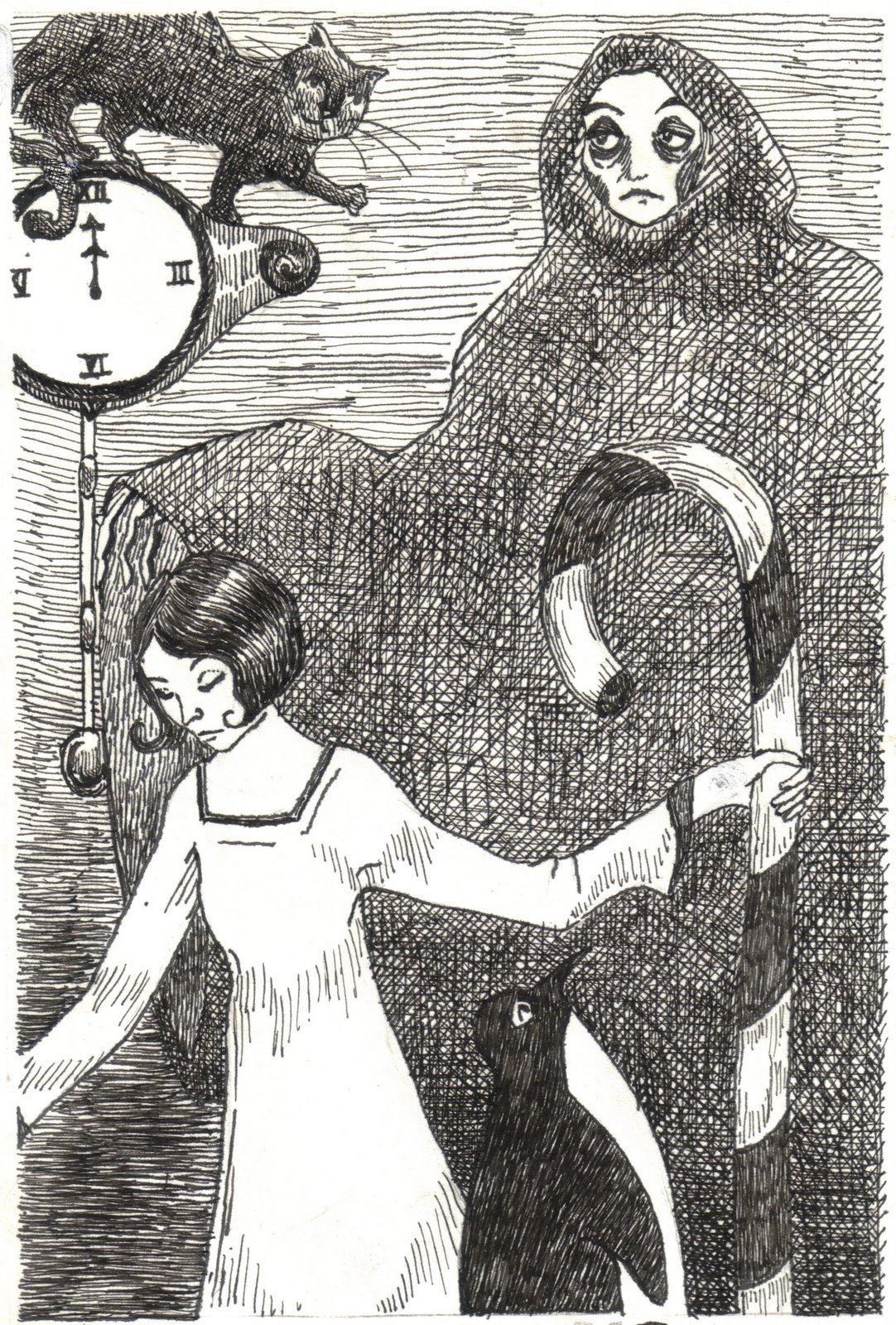
This is the old notebook holy grail image as far as I am concerned. A clown dystopia where all the fish have disappeared. It had to do with some long abandoned project that I can't even remember. Click on it to enlarge so you can read the captions.


Friday, July 9, 2010
Apocalypse Girls Strike Back: The Sequels
 Pretty much every zombie story I've ever watched or read is set when zombies are new. People from our civilization, people just like us, contending with this new scourge. What's so interesting about both Carrie Ryan's Forest of Hands and Teeth, and its sequel (or as she calls it, it's companion novel) The Dead-Tossed Waves, is that her characters and their families have lived with zombies for generations. They are a fact of the world they live in as much as car accidents or muggings are in ours.
As in her first book, Ryan's imagining of this post-industrial, decimated United States is one of the best things about it. Waves is set some 30 years or so after the end of the previous novel, and we follow Gabrielle (or Gabry), Mary - the protagonist from Forest's daughter. She has grown up in a lighthouse in a small community next to a decaying amusement park. All the towns are walled, to keep out the undead, much as towns in medieval times were (but they had fewer zombies). The tone is elegiac, as people's lives are almost unbearably hard. Everyone looks back to the time before "The Return" (i.e. the zombie apocalypse), but without technology, the books, the science, all of it is being forgotten. This is Ryan at her strongest. What I found a little less compelling was the romance. As in her first book, there is a tragic love triangle. The relationship that springs up between Gabry and one of the young men in the story seemed overly telegraphed. The whole thing seemed kind of rote.
One thing I liked about both of Ryan's books was that her heroines in each were so flawed, and problematic. Gabry isn't the most admirable teenager. By the book's end she's a murderer, and the fact of that wasn't really satisfactorily dealt with. The murder made sense for what we had learned about Gabry, who wasn't painted as the strongest character. But it was never discussed. No one in the book ever suggested to her that maybe she could have had another choice. There is obviously going to be another installment, so I hope the matter isn't dropped. Ryan is a good writer, but this entry in her saga took a while to get cooking, I feel as another draft may have been a good idea. I also kept on thinking about what a friend of mine said once about Twilight on facebook: that for all its problems, it does romance really, really well, when in most YA books the obligatory romance usually seems a little forced.
Catching Fire is Suzanne Ryan's second entry in her Hunger Games Trilogy (the next book is due out this summer), and as with her first, the thing is like crack cocaine. Unless you have a much stronger fiction reading constitution than I do, you will be up late finishing it. It picks up where the first book leaves off, with Katniss Everdeen having won the vicious games (for a description, go to my last blog post - the link is above). Her win and its circumstances has helped foment dissent in Panem (the post-apocalyptic country that used to be the United States), and the government is responding the way dictatorships usually respond to imminent revolution - with brutality.

I loved this book. Collins writes popular fiction the way it should be done - clearly, intelligently, and grippingly. Unlike Dan Brown and his ilk, she can write. I found the love triangle in the first book to be somewhat irksome, but in this one I had no problem with it. Katness has been put in an untenable situation. She is being pulled and manipulated by President Snow and his government, by the media (government run), by the burgeoning revolutionary forces who see her as a symbol of their cause, by her neighbors who mostly want to keep their heads down and to work and not starve. Her romantic life has lost all sense of authenticity, as part of her popular "character" (think in terms of reality television) is the romance with her fellow Hunger Games contestant, Peeta, which started off as a lie, but there may be real feelings there, but there has been so much dissembling at this point, no sane person would be able to see their way clearly. This is complicated stuff for a book aimed at 14 year olds.
Collins has created a real-seeming, tough world. Very bad things happen to people we like. When the government cracks down, it is like the Soviet Union under Stalin. There is no reality, only "reality". People inform on each other, no one trusts that the phones or their homes aren't bugged. As the book ends, true revolution has begun and I'm extremely curious to see what will happen. The government Collins has invented is a nightmare, but she's smart enough to make Katniss suspicious of the revolutionary forces who hold her natural sympathies. They act with the expedience and disregard for individual life that is endemic in revolutions. This isn't Luke and friends defeating the Empire, for which Collins should be commended. I think her books might actually be kind of great. Katniss is a terrific hero, in the great tradition of heroes: she's reluctant to be one. I also love that her toughness and resilience comes from the life she's led: not from special training, or magic skills, or the kiss of a good witch. She's a good hunter because she was brutally poor and her father was dead. She's tough because if she wasn't she wouldn't have survived the famine and poverty of her mining town. The only fault I found with the book, was the one that is endemic to middle books in trilogies - there is a lot of dealing with the repercussions of book one and leading into the final conflicts of book three. That said, even with another round of Hunger Games, I didn't find it to be particularly repetitive, and am avidly looking forward to the next installment.
Mockingjay - book #3 - is out on August 24.
Monday, March 29, 2010
Apocalypse Girls 2: Hunger Games and Heroes & Villains
More dystopian fun! Apocalypse Girls 1 can be found here.
 Suzanne Collins's The Hunger Games is a publishing sensation. Since it came out in 2008, it has sold nearly 1.5 million copies. Obviously, this means we will be seeing a lot more YA post-apocalyptic novels over the next few years fighting the vampires and Potter rip-offs for shelf space in an ever narrowing spiral of diminishing returns.
After reading it, I can easily understand its popularity. Once you start, against all kinds of better judgment, it is simply impossible wrench the damn thing away from your greedy eyeballs. The heroine, Katniss Everdeen is smart and unsentimental. The world building is outstanding. The United States is long gone, replaced by the nation of Panem. The country is divided into twelve districts, a thirteenth was obliterated after a failed rebellion against the ruling Capital. In repayment for this disloyalty, every year the districts have to each offer up a boy and a girl (this is done by lottery) to participate in The Hunger Games, which is televised nationally, and obsessively watched by everyone. The games themselves are like a cross between Survivor and the Olympics, but with actual killing. The only rule (unspoken) is "no cannibalism". Last teen standing wins and becomes a pampered celebrity for life. As Stephen King pointed out in his EW review (with which I basically agree), this isn't the most mind-blowingly original premise. But to much of its school age readership, it will be.
As compulsively readable as the book is, it's not perfect. As with most teen novels, there is a love triangle, which after all my recent YA reading is getting increasingly irksome. My biggest problem with the book is with the action that happens once the Hunger Games begin. At times the action sequences began to drag for me. I'm probably a total fuddy-duddy, but amidst all the violence, I would sigh and say to myself, "Nothing is happening". Meaning that nothing is happening internally, no growth, no interesting thoughts, the plot isn't actually moving forward. It would get a little boringly filmic. And then I thought there was a failing of courage in Collins at the very end. This might be my predilection for heartbreak and misery raising its ugly head (again), but the ending felt easy to me.
All that aside, unlike with Uglies/Pretties, I already have the sequel sitting on my shelf and I'm really itching to start devouring it. Though she may occasionally lose her way, Collins is thoughtful and smart about the political and class structure she has invented, and the characters are compelling. Katniss comes from a brutally poor mining town in what was once what we would call Appalachia. No one from their district has won the Games in decades, as they lack the wealthy sponsors that help keep contestants from the more affluent districts alive. She is an appealing heroine, more complicated than most - filled with guilt and a crushing sense of responsibility.
And not everyone can write the teen lit equivalent of crack cocaine.
 Heroes & Villains differentiates itself from the other books on this list in that it was written by Angela Carter. Literature-wise, she is the only serious heavyweight present, and as most people who know me are aware, she's my favorite writer of the last hundred years or so. I've been slowly rationing out her books so that I don't run out too soon, but I'm afraid I've read nearly everything.
Heroes & Villains was her fourth novel, published when she was twenty-nine years old in 1969, the year I was born. It tells the story of Marianne who lives in a tower in a town surrounded by woods, the daughter of scientists. In her post-nuclear world, outside the gates are Barbarians who according to current scientific thought have branched off from Homo Sapiens and formed a new sub-species. Mutated beasts (zoo escapees) also wander the forests.
It's difficult for me to write about this book specifically without writing about Angela Carter in a wider context - there will be more soon in a later blog post (tentatively titled "Angela Carter Was The Greatest Writer of the Second Half of the 20th Century and Anyone Who Thinks I'm Wrong Can Go Fuck Themselves"). She was a working class Scott raised in London, educated at Cambridge, a novelist, a scholar of fairy tales and literature, a short story writer, a critic, a translator, a writer of radio plays, a Socialist, a mother, a failed anorexic. She was also a Feminist of the most interesting, contrarian and least politically correct stripe. Her ideas on gender and colonialism permeate all of her work, and at one point or another she managed to infuriate everyone. She was a particularly thorny figure to the McKinnon/Dworkin sackcloth and ashes brand of feminism that was most prevalent in the 70s when Angela Carter was causing trouble. After all, this is the woman who wrote a book long feminist defense of the Marquis de Sade, and purposefully wrote a misogynist novel in the spirit of intellectual curiosity (which I'm kind of dying to adapt for the stage).
So, her teen dystopian novel carries a different sort of weight from the others, but it still fits in seamlessly. The first line of the book, "Marianne had sharp, cold eyes but her father loved her." is straight out of the world of fairy tales. Early in the book, Marianne runs away with one of the barbarians who attack her enclave: it's part desperation, part defiance and part a kidnapping. Life with the barbarians is a jumble of gypsy mythos, the American west (i.e. The Searchers, but here, no one cares for or is looking for Natalie Wood), baroque, gothic decay, and a large dollop of The Tempest. It's a heady mix, but in all her extravagance of language and legend, she never loses sight of the central question of otherness and identity. She plays with all sorts of tropes from myth and romance, most tellingly the constant and always disturbing one of falling in love with one's rapist. I have a feeling that the men reading this won't know exactly how pervasive this is, as they haven't watched enough soap operas or read enough best-selling romances. Think Gone With the Wind, Luke and Laura or even my beloved Buffy. When Angela Carter goes there, it is with such intent, one can almost see her looking up from her typewriter and saying, "Yeah. I fucking went there. Let's see where it leads." It's a strange, powerful book, though far from her best. The ending felt a little unfinished, with its strange evocation of Rousseau (actually, now that I think of it, both Rousseaus, which I'm sure was intentional).
Angela Carter wore her influences on her sleeve. But she never loses sight of what she's getting at, and why tropes and popular fiction are so meaningful. Similar in some ways to one of my other gigantic influences, Dennis Potter. It's no accident that genre moves people so deeply. Pop sensibilities are as valuable as any other, and more than most, I think. But going back to dystopia, and why girls at this particular moment in time seem so drawn to it. I really don't have any trenchant insights other than the obvious ones of teens wanting their alienated insides made literal. I think it's particularly tough times out there in the culture for girls. So much is expected of them, and so many of these things are seemingly contradictory: one of the most insidious is the myth of effortlessness. I mean, what wonder teen is effortless at anything at fifteen. I'm leaving boys out of this equation only because I don't know anything about boys. I do think girls are alienated from the center of our culture from their very core and maybe these books speak to that. All that aside, it is certainly an interesting time for literature aimed at young girls for which I am grateful.
 Suzanne Collins's The Hunger Games is a publishing sensation. Since it came out in 2008, it has sold nearly 1.5 million copies. Obviously, this means we will be seeing a lot more YA post-apocalyptic novels over the next few years fighting the vampires and Potter rip-offs for shelf space in an ever narrowing spiral of diminishing returns.
After reading it, I can easily understand its popularity. Once you start, against all kinds of better judgment, it is simply impossible wrench the damn thing away from your greedy eyeballs. The heroine, Katniss Everdeen is smart and unsentimental. The world building is outstanding. The United States is long gone, replaced by the nation of Panem. The country is divided into twelve districts, a thirteenth was obliterated after a failed rebellion against the ruling Capital. In repayment for this disloyalty, every year the districts have to each offer up a boy and a girl (this is done by lottery) to participate in The Hunger Games, which is televised nationally, and obsessively watched by everyone. The games themselves are like a cross between Survivor and the Olympics, but with actual killing. The only rule (unspoken) is "no cannibalism". Last teen standing wins and becomes a pampered celebrity for life. As Stephen King pointed out in his EW review (with which I basically agree), this isn't the most mind-blowingly original premise. But to much of its school age readership, it will be.
As compulsively readable as the book is, it's not perfect. As with most teen novels, there is a love triangle, which after all my recent YA reading is getting increasingly irksome. My biggest problem with the book is with the action that happens once the Hunger Games begin. At times the action sequences began to drag for me. I'm probably a total fuddy-duddy, but amidst all the violence, I would sigh and say to myself, "Nothing is happening". Meaning that nothing is happening internally, no growth, no interesting thoughts, the plot isn't actually moving forward. It would get a little boringly filmic. And then I thought there was a failing of courage in Collins at the very end. This might be my predilection for heartbreak and misery raising its ugly head (again), but the ending felt easy to me.
All that aside, unlike with Uglies/Pretties, I already have the sequel sitting on my shelf and I'm really itching to start devouring it. Though she may occasionally lose her way, Collins is thoughtful and smart about the political and class structure she has invented, and the characters are compelling. Katniss comes from a brutally poor mining town in what was once what we would call Appalachia. No one from their district has won the Games in decades, as they lack the wealthy sponsors that help keep contestants from the more affluent districts alive. She is an appealing heroine, more complicated than most - filled with guilt and a crushing sense of responsibility.
And not everyone can write the teen lit equivalent of crack cocaine.
 Heroes & Villains differentiates itself from the other books on this list in that it was written by Angela Carter. Literature-wise, she is the only serious heavyweight present, and as most people who know me are aware, she's my favorite writer of the last hundred years or so. I've been slowly rationing out her books so that I don't run out too soon, but I'm afraid I've read nearly everything.
Heroes & Villains was her fourth novel, published when she was twenty-nine years old in 1969, the year I was born. It tells the story of Marianne who lives in a tower in a town surrounded by woods, the daughter of scientists. In her post-nuclear world, outside the gates are Barbarians who according to current scientific thought have branched off from Homo Sapiens and formed a new sub-species. Mutated beasts (zoo escapees) also wander the forests.
It's difficult for me to write about this book specifically without writing about Angela Carter in a wider context - there will be more soon in a later blog post (tentatively titled "Angela Carter Was The Greatest Writer of the Second Half of the 20th Century and Anyone Who Thinks I'm Wrong Can Go Fuck Themselves"). She was a working class Scott raised in London, educated at Cambridge, a novelist, a scholar of fairy tales and literature, a short story writer, a critic, a translator, a writer of radio plays, a Socialist, a mother, a failed anorexic. She was also a Feminist of the most interesting, contrarian and least politically correct stripe. Her ideas on gender and colonialism permeate all of her work, and at one point or another she managed to infuriate everyone. She was a particularly thorny figure to the McKinnon/Dworkin sackcloth and ashes brand of feminism that was most prevalent in the 70s when Angela Carter was causing trouble. After all, this is the woman who wrote a book long feminist defense of the Marquis de Sade, and purposefully wrote a misogynist novel in the spirit of intellectual curiosity (which I'm kind of dying to adapt for the stage).
So, her teen dystopian novel carries a different sort of weight from the others, but it still fits in seamlessly. The first line of the book, "Marianne had sharp, cold eyes but her father loved her." is straight out of the world of fairy tales. Early in the book, Marianne runs away with one of the barbarians who attack her enclave: it's part desperation, part defiance and part a kidnapping. Life with the barbarians is a jumble of gypsy mythos, the American west (i.e. The Searchers, but here, no one cares for or is looking for Natalie Wood), baroque, gothic decay, and a large dollop of The Tempest. It's a heady mix, but in all her extravagance of language and legend, she never loses sight of the central question of otherness and identity. She plays with all sorts of tropes from myth and romance, most tellingly the constant and always disturbing one of falling in love with one's rapist. I have a feeling that the men reading this won't know exactly how pervasive this is, as they haven't watched enough soap operas or read enough best-selling romances. Think Gone With the Wind, Luke and Laura or even my beloved Buffy. When Angela Carter goes there, it is with such intent, one can almost see her looking up from her typewriter and saying, "Yeah. I fucking went there. Let's see where it leads." It's a strange, powerful book, though far from her best. The ending felt a little unfinished, with its strange evocation of Rousseau (actually, now that I think of it, both Rousseaus, which I'm sure was intentional).
Angela Carter wore her influences on her sleeve. But she never loses sight of what she's getting at, and why tropes and popular fiction are so meaningful. Similar in some ways to one of my other gigantic influences, Dennis Potter. It's no accident that genre moves people so deeply. Pop sensibilities are as valuable as any other, and more than most, I think. But going back to dystopia, and why girls at this particular moment in time seem so drawn to it. I really don't have any trenchant insights other than the obvious ones of teens wanting their alienated insides made literal. I think it's particularly tough times out there in the culture for girls. So much is expected of them, and so many of these things are seemingly contradictory: one of the most insidious is the myth of effortlessness. I mean, what wonder teen is effortless at anything at fifteen. I'm leaving boys out of this equation only because I don't know anything about boys. I do think girls are alienated from the center of our culture from their very core and maybe these books speak to that. All that aside, it is certainly an interesting time for literature aimed at young girls for which I am grateful.
Monday, February 22, 2010
Apocalypse Girls 1: Rite of Passage, Forest of Hands and Teeth and Uglies
From what I understand, there are numerous possible causes. Over-population. Nuclear war. Regular war. A bacteria that attacks gasoline. Famine. And, of course, zombies. I'm talking about apocalypse. Disaster, Armageddon, or as the Greeks had it: revelation. I think in some way, what comes after the destruction is what will be revealed. Don't worry, I'm not getting all fatalistic and doomy - I'm talking about literature. Over the past few months I've read five (count 'em - five!) books that were post-apocalyptic in one way or another, all with teen girl protagonists.
All were interesting, all were worth reading to varying degrees. Two were from the late 60s, and the other three have all been released over the past couple of years. Young Adult fantasy is incredibly popular right now (Twilight. Duh.), most of it with female protagonists, much of it very good indeed. It just seemed such an odd coincidence that I read all these books in such close proximity to each other. As someone on a YA book board recently exclaimed: "Is post-apocalyptic teen fiction now a genre?"
 When Rite of Passage by Alexei Panshin first came out in 1968, it won the Nebula and was a Hugo Award finalist. So it's not like is was exactly ignored upon its release. At first, I wasn't going to include it in my post as this is actually a re-read. It was one of my favorite books when I was a teenager, so it seems like a total shame that kids now don't seem to be reading it much. The story is set about 150 years after the Earth became uninhabitable do to overpopulation, famine and war. Mia Havero, who is eleven years old when the book starts, lives aboard one of several large, city sized ships that escaped Earth before its final destruction. Numerous colonies have also been set up on various planets. One thing that surprised me upon rereading was how unlikable Mia sometimes is. She's prickly, impatient and intolerant. She throws around the word "mudeaters", the slur the ship dwellers use to denigrate the people who live on the planets. She is smart and arrogant. But she's also brave and intellectually curious. In a closed society like the Ship's, there is little disease, few accidents and people live a very, very long time, so population control is of prime importance to the ship's counsel. One of the ways this is effected is through "The Trial". When kids turn fourteen, they are put down on a planet and have to survive for a month. They are given extensive survivalist training in order to ensure that a good number make it through.
By the end of the book, we view the Ship as being a kind of lazy Death Star without the histrionics, Nazi iconography and ultra-militarism. Ship society has become decadent, complacent and arrogant (much as Mia was at the beginning of the book). No one creates any new art, they take resources from and exert ultimate control (via the threat of nuclear annihilation) over the planet colonies, withholding technology from the hard-scrabble, mostly rural planet dwellers. What's so interesting, and feels so real about the book is that Mia's father who is a firm supporter of all the policies outlined above, is also in the ordinary, day to day sense, a very nice man. Everyone thinks they are right and working for the ultimate good in their own quiet way. There is no mustache twirling, no clear villains and no easy solutions. There's no rebellion of the planet dwellers creating a new egalitarian society. There's just one girl's awakening to the fact that the way her Ship operates isn't right and that she will do what she can to change things. If I've made this sound overly dry, I apologize. Though Panshin is a slightly chilly writer emotionally, Mia's month long Trial is super exciting (and - bonus! consequence-free teen sex!) and her adventures aboard ship are loads of fun, and there's lots of regular coming of age stuff with friends and school. The title "Rite of Passage" may be heavy handed, but the book isn't. I have a feeling one of the big problems with people not reading this book are the really unfortunate covers it has been saddled with for the past 2o years. I mean, really.
 The Forest of Hands and Teeth by first-time novelist Carrie Ryan, is a muted Zombie Apocalypse romance that is full of dread. I mean that in the nicest way possible. She never uses the word "zombie" in her book, the creatures in the forest are instead referred to as the "Unconsecrated". Becoming unconsecrated is viewed as both a disease and a curse.
The novel is set some generations after the Unconsecrated have seemingly overrun the earth. Mary lives in a small, fortified village in the forest which is run along strict religious lines by an order of Sisters, backed up by the force of the Guardians who patrol the borders. I say "seemingly" because there don't seem to be any lines of communication open between Mary's town and the rest of the world. She isn't certain there is a "rest of the world". The town is bordered by a fence, beyond which is the Forest of Hands and Teeth - the hunting ground of the unconsecrated.
I took a look at a few reviews before writing this, and everyone describes the book in the same way. They use simple fairy tale sentences. There is a girl named Mary and she lives in a town surrounded by woods. The first half of the book is extremely powerful. It doesn't feel entirely unlike a story about a medieval village when the black plague comes to town. She hits that sweet spot between specificity and universal allegory that is very, very hard to do. You can get a pretty good feel for it from the lovely first paragraph:
 Scott Westerfield's Uglies books have an interesting premise (out of the four, I read the first two: Uglies and Pretties), but felt overly simple in execution. I enjoyed the first book. Our teenage heroine, Tally Youngblood, lives in a post-apocalyptic, post-scarcity, seeming utopia. When each person turns sixteen they are made "pretty". i.e. they are given head to toe plastic surgery and move to "New Pretty Town", a kind of late adolescent Pleasure Island of parties and cocktails and fun and decadence. Kids who haven't yet had the surgery are called "Uglies". Tally wants to be pretty more than anything. If you smell a dystopia looming, you'd be correct. It's creepy as hell, and Tally learns a few things that puncture her pretty-perfect view of the world she was born into. She learns about the big brother-like Secret Police (called Specials) who have been surgically altered to be strong, fast and monstrous. She also learns about, and eventually makes her way to "The Smoke", a camp of deserters who live in the wilderness, un-surgeried. While there, even more sinister facts emerge. The new pretties aren't so up and "bubbly" (and, wow, will you get sick of the word bubbly in the second book) because their lives are now so fabulous, but because they've been essentially lobotomized, and made docile.
This is spooky, potent stuff, and Westerfield tells an exciting tale. But something about it felt overly simple to me. Some of the technology he has thought up is awe inspiring (particularly in "Pretties") and creative, but sometimes they felt like plot contrivances. The Specials are completely evil. Which I guess is partly my problem - in contrast between Mia Havero's nice father deciding to push the button to annihilate an entire planet because he really, really thinks its his only choice - we have what I call mustache twirling. Evil for evil's sake that delights in its own evil. I mean, they do say they want to preserve their way of life and look what happened before, etc. But they practically kick puppies. Also, the major betrayal and the reaction to it felt off. It's over a boy that Tally's friend liked first. And when he likes Tally better she becomes completely evil. Which is just stupid. The characters are at the service of the plot.
If I can get it for free, I may read "Specials" to see how it all turns out (here's a hint: evil loses), but Westerfield's world, while very sparkly indeed, lacks depth. And maybe it just hit me wrong, but Westerfield seems awfully enchanted by the Pretties outsides, while bemoaning their insides. Which doesn't sound very different from certain dystopian aspects of our our current, non-apocalyptic world.
Apocalypse Girls will continue with Suzanne Collins' Hunger Games and Angela Carter's Heroes & Villains.
All were interesting, all were worth reading to varying degrees. Two were from the late 60s, and the other three have all been released over the past couple of years. Young Adult fantasy is incredibly popular right now (Twilight. Duh.), most of it with female protagonists, much of it very good indeed. It just seemed such an odd coincidence that I read all these books in such close proximity to each other. As someone on a YA book board recently exclaimed: "Is post-apocalyptic teen fiction now a genre?"
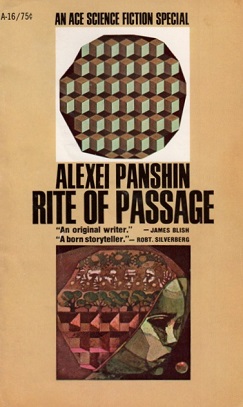 When Rite of Passage by Alexei Panshin first came out in 1968, it won the Nebula and was a Hugo Award finalist. So it's not like is was exactly ignored upon its release. At first, I wasn't going to include it in my post as this is actually a re-read. It was one of my favorite books when I was a teenager, so it seems like a total shame that kids now don't seem to be reading it much. The story is set about 150 years after the Earth became uninhabitable do to overpopulation, famine and war. Mia Havero, who is eleven years old when the book starts, lives aboard one of several large, city sized ships that escaped Earth before its final destruction. Numerous colonies have also been set up on various planets. One thing that surprised me upon rereading was how unlikable Mia sometimes is. She's prickly, impatient and intolerant. She throws around the word "mudeaters", the slur the ship dwellers use to denigrate the people who live on the planets. She is smart and arrogant. But she's also brave and intellectually curious. In a closed society like the Ship's, there is little disease, few accidents and people live a very, very long time, so population control is of prime importance to the ship's counsel. One of the ways this is effected is through "The Trial". When kids turn fourteen, they are put down on a planet and have to survive for a month. They are given extensive survivalist training in order to ensure that a good number make it through.
By the end of the book, we view the Ship as being a kind of lazy Death Star without the histrionics, Nazi iconography and ultra-militarism. Ship society has become decadent, complacent and arrogant (much as Mia was at the beginning of the book). No one creates any new art, they take resources from and exert ultimate control (via the threat of nuclear annihilation) over the planet colonies, withholding technology from the hard-scrabble, mostly rural planet dwellers. What's so interesting, and feels so real about the book is that Mia's father who is a firm supporter of all the policies outlined above, is also in the ordinary, day to day sense, a very nice man. Everyone thinks they are right and working for the ultimate good in their own quiet way. There is no mustache twirling, no clear villains and no easy solutions. There's no rebellion of the planet dwellers creating a new egalitarian society. There's just one girl's awakening to the fact that the way her Ship operates isn't right and that she will do what she can to change things. If I've made this sound overly dry, I apologize. Though Panshin is a slightly chilly writer emotionally, Mia's month long Trial is super exciting (and - bonus! consequence-free teen sex!) and her adventures aboard ship are loads of fun, and there's lots of regular coming of age stuff with friends and school. The title "Rite of Passage" may be heavy handed, but the book isn't. I have a feeling one of the big problems with people not reading this book are the really unfortunate covers it has been saddled with for the past 2o years. I mean, really.
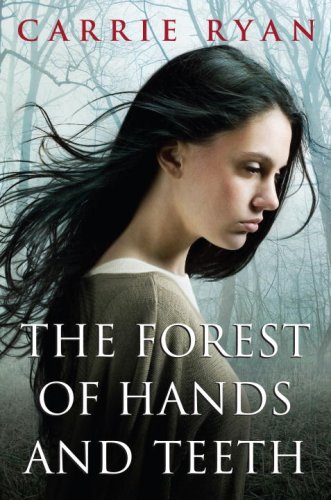 The Forest of Hands and Teeth by first-time novelist Carrie Ryan, is a muted Zombie Apocalypse romance that is full of dread. I mean that in the nicest way possible. She never uses the word "zombie" in her book, the creatures in the forest are instead referred to as the "Unconsecrated". Becoming unconsecrated is viewed as both a disease and a curse.
The novel is set some generations after the Unconsecrated have seemingly overrun the earth. Mary lives in a small, fortified village in the forest which is run along strict religious lines by an order of Sisters, backed up by the force of the Guardians who patrol the borders. I say "seemingly" because there don't seem to be any lines of communication open between Mary's town and the rest of the world. She isn't certain there is a "rest of the world". The town is bordered by a fence, beyond which is the Forest of Hands and Teeth - the hunting ground of the unconsecrated.
I took a look at a few reviews before writing this, and everyone describes the book in the same way. They use simple fairy tale sentences. There is a girl named Mary and she lives in a town surrounded by woods. The first half of the book is extremely powerful. It doesn't feel entirely unlike a story about a medieval village when the black plague comes to town. She hits that sweet spot between specificity and universal allegory that is very, very hard to do. You can get a pretty good feel for it from the lovely first paragraph:
My mother used to tell me about the ocean. She said there was a place where there was nothing but water as far as you could see and it was always moving, rushing toward you and then away. She once showed me a picture that she said was my great-great-great-grandmother standing in the ocean as a child. It has been years since, and the picture was lost to fire long ago, but I remember it, faded and worn. A little girl surrounded by nothingness.I think the book falls apart a little at the end. Mary and a few others wind up traveling down a fenced in path, the unconsecrated hoards constantly trying to break through. Look. I'm all for zombies. But after a week of them traveling like this, I began to ask, "What is that fence made of?" Ryan seemed to lose control a little bit as the masses of zombies swamp the narrative in yuck and gore. There are just too many of them. Which I guess is the whole point of a zombie apocalypse so I can't complain. But all of Ryan's missteps feel like rookie errors and she has a sequel on the way which I am very excited about (called The Dead-Tossed Waves. Out in March.). From the advance materials, it looks as if it doesn't pick up directly from where Forest left off, but skips a generation or so. I think this was a smart move and I'm curious to see where her lovely prose and morally complex zombie world wind up leading.
 Scott Westerfield's Uglies books have an interesting premise (out of the four, I read the first two: Uglies and Pretties), but felt overly simple in execution. I enjoyed the first book. Our teenage heroine, Tally Youngblood, lives in a post-apocalyptic, post-scarcity, seeming utopia. When each person turns sixteen they are made "pretty". i.e. they are given head to toe plastic surgery and move to "New Pretty Town", a kind of late adolescent Pleasure Island of parties and cocktails and fun and decadence. Kids who haven't yet had the surgery are called "Uglies". Tally wants to be pretty more than anything. If you smell a dystopia looming, you'd be correct. It's creepy as hell, and Tally learns a few things that puncture her pretty-perfect view of the world she was born into. She learns about the big brother-like Secret Police (called Specials) who have been surgically altered to be strong, fast and monstrous. She also learns about, and eventually makes her way to "The Smoke", a camp of deserters who live in the wilderness, un-surgeried. While there, even more sinister facts emerge. The new pretties aren't so up and "bubbly" (and, wow, will you get sick of the word bubbly in the second book) because their lives are now so fabulous, but because they've been essentially lobotomized, and made docile.
This is spooky, potent stuff, and Westerfield tells an exciting tale. But something about it felt overly simple to me. Some of the technology he has thought up is awe inspiring (particularly in "Pretties") and creative, but sometimes they felt like plot contrivances. The Specials are completely evil. Which I guess is partly my problem - in contrast between Mia Havero's nice father deciding to push the button to annihilate an entire planet because he really, really thinks its his only choice - we have what I call mustache twirling. Evil for evil's sake that delights in its own evil. I mean, they do say they want to preserve their way of life and look what happened before, etc. But they practically kick puppies. Also, the major betrayal and the reaction to it felt off. It's over a boy that Tally's friend liked first. And when he likes Tally better she becomes completely evil. Which is just stupid. The characters are at the service of the plot.
If I can get it for free, I may read "Specials" to see how it all turns out (here's a hint: evil loses), but Westerfield's world, while very sparkly indeed, lacks depth. And maybe it just hit me wrong, but Westerfield seems awfully enchanted by the Pretties outsides, while bemoaning their insides. Which doesn't sound very different from certain dystopian aspects of our our current, non-apocalyptic world.
Apocalypse Girls will continue with Suzanne Collins' Hunger Games and Angela Carter's Heroes & Villains.
Subscribe to:
Posts (Atom)


 Posts
Posts