American's aren't terribly comfortable with the concept of aging or death. Wealthy women pump chemicals into their faces in attempts to preserve the dewy skin of youth, but the practice backfires more often than not, lending these unhappy, deluded souls the look of well preserved corpses laid out for burial. Old people are encouraged to live in ghettos called "retirement communities", where the only people required to deal with them are paid care givers, and each other.
Americans do, however, enjoy the pageantry of death. We celebrate Halloween, that ancient rite of death and rebirth and harvest. We love horror movies full of bloody corpses and basic cable is full of shows that consist mainly of men with recording devices shouting "Are you there?" and freaking themselves out, hoping and fearing that an actual ghost will appear. We're pretty good at talking about tragedy. But dealing with death as a part of life and the idea that all of us are one day going to shake off this mortal coil, well, that's pretty much unAmerican. We like optimism.
Our neighbors to the south celebrate death with great and storied pageantry. Día de los Muertos celebrates those one has loved and lost to the aether, one prays and eats and celebrates. It is a fitting holiday for the world's most popular death cult, Catholicism. It is this holiday that Mexican illustrator and artist, José Guadalupe Posada, is most deeply associated. His images of skeletons are justly iconic, but they really were a tiny fragment of his work. Born in 1852, he spent the bulk of his working life in Mexico City, drawing political broadsides and illustrating an amazing array of chapbooks. Interestingly, his drawings of skeletons weren't really intended to celebrate Día de los Muertos at all. The iconic La Calavera Catrina (the skinny lady in the hat pictured above) was drawn to mock the rich, saying that no matter how lovely and expensive your clothes, you too, will one day be dust and ashes like the rest of us.
A few years ago, I was smart enough to pick up a copy of Posada: Illustrator of Chapbooks. In it, are dozens of his penny chapbook illustrations. It's remarkable that so many have survived as they were considered to be pretty much disposable at the time of their publication, and the quality of the paper is terrible. Luckily, the company that produced them kept excellent archives which were lovingly cared for by the owner's descendants. Also, Posada was a wonderful artist and people aren't completely stupid. Many people held on to them. Like any jobbing illustrator, he drew many, many subjects, but they are all identifiable as his work.
I love fine art, but in some ways the applied arts: illustration, cartooning, graphic design, fashion tell us more about the texture of times past then anything else. This was the stuff that people looked at every day, what they had in their homes, and what they saw on the streets on their way to work. These were the images that lived in people's heads.
Posada died, like many illustrators of the past century, penniless and nearly forgotten. Unsurprisingly, Diego Rivera was one of the people who called attention his work long after Posada's death. His satirical edge, which is palpable in all his work, even in his illustrations for children's stories, fits in so well with the modern sensibility. Unlike with many contemporaries in England and America whose work seems cloying or dated, his does not. Posada is more akin to near contemporary, Thomas Nast, whose work was even more overtly political, but was protected by the First Amendment, a luxury Posada did not possess.
It was Mondo and his final runway collection wearing its Day of the Dead and Mexican folk art influences on its sleeve that made me want to revisit Posada. Art talks to each other, and it talks to us. Give Posada a look.
Now that I've broken up with my television love, what do I do now?
Well, last year, when Bravo finally lost the acrimonious court case that ensured that Project Runway (I type those words with deep bitterness) would move to Lifetime, they developed a new competition reality show for emerging designers creatively titled, The Fashion Show. Isaac Mizrahi starred as kind of a Tim Gunn/Tom Coliccio hybrid, playing both mentor and judge. Mizrahi is a wonderful designer and has been an entertaining media presence for nearly two decades. So much, so good. But for some reason, his charm didn't translate very well to this forum. He seemed uncomfortable and affected.
I think pretty much everyone knows that the smartest thing the Magical Elves ever did was hiring Tim Gunn to act as mentor on Project Runway (sigh). The fact that they found someone as all around wonderful as he is, is of course, a miracle. But they should be lauded to the skies for interviewing him to begin with, as he was in no way an obvious choice for this sort of television show. He went to school for sculpture, then taught at Parsons School of Design for 25 years, the last seven of which he spent as chairman of their prestigious Fashion Design program. In other words, they had the foresight to think that maybe someone who has spent the bulk of their career in education might be a wise choice for mentor. Rather than, say, a pop star whose career was rapidly fading.
Which brings us to The Fashion Show v.1's most egregious error: the Kelly Rowland debacle. Now, Kelly Rowland has a nice singing voice as she proved when she was one of the members of Destiny's Child who happened not to be Beyoncé. If she had been pegged to be a judge or the host or whatnot on a singing competition show, it would make sense. As that is what Ms. Rowland does for a living. She is not a fashion designer, a fashion magazine editor, or a fashion model. She does, however, like the rest of us, wear clothing. This seemed to be her only qualification, unfortunately. She used to trail around after Mizrahi and give advice to the designers. This is pretty much equivalent to me walking around the Top Chef kitchen giving advice to the cheftestants because I have a lifetime of experience eating. It was patently ridiculous and the show suffered.
I tried watching it and kind of vaguely meant to stick with it and then I suddenly realized the whole thing was over and I had completely stopped bothering to watch. And I feel the need to add that this was when I was in the midst of a major depression and basically spent most of my time on the couch weeping, eating nachos and watching reality television. I mean, I watched that horrible Matchmaker show, but I couldn't be bothered to stick with The Fashion Show, which could be best described as: Just like Project Runway (sigh), but terrible. And I've always been fond of Isaac Mizrahi and was willing to cut him some slack, but no.
No one seemed to like it, the reviews were pretty uniformly bad, so I was surprised to see it coming back for a second season. But! They have majorly retooled the show so that it seems less like a sad imitation of (sob!) Project Runway. Kelly Rowland has been jettisoned, and she's been replaced by Iman. They really couldn't have come up with a better choice. She's a legendary fashion professional. She's intelligent, articulate and strongly opined. Mizrahi also seems more relaxed now that he doesn't have Rowland trailing along after him. The show is still far from perfect, though the emphasis on team work is interesting. There is still too much emphasis placed on "personalities" rather than the work. It's nice to see the judges (which include a Harper's Bazaar editor in addition to Mizrahi and Iman) calling out insufferable behavior, but it's frustrating to see it rewarded with airtime. Uncle Tim and Klum would never put up with this level of nonsense. But, the bulk of the designers seem nice enough and a few have created some lovely pieces.
When one's heart has been broken, after the inevitable moping around has become tiresome, I believe one should move on. I've seen two episodes of The Fashion Show (oh my God do I hate that title), but I'm not in love. They still feel as if they're trying a little too hard. But the producers seemed to have understood what the problems were in the first season, and have done a pretty good job at remedying them. The lovely presence of Mrs. Bowie is what is keeping me around for now. But the challenges and the judges decisions need to be interesting and accurate, or I'm gone. I'm still fragile.
Below, the runway show from 1995 documentary, Unzipped, incidentally proving that grownup women with personalities make much more entertaining models than armies of interchangeable fifteen year olds.
We seem to be in the midst of something like an old timey movie golden age here at the beginning of the teens in the 21st century. Silent movie festivals are happening all over the place, and seemingly every movie ever filmed (that hasn't been lost or incinerated) is on DVD or on the internet. It never stops being thrilling to me.
That said, if you aren't watching Turner Classic Movies's new documentary series, Moguls & Movie Stars: A History of Hollywood, you are truly missing out. It's thrilling history, and the rarities being shown after the airing of each episode are added fabulousness. They do a terrific job of putting what was happening in a particular time in film history into a more general historical context.
Exciting to the author of this blog, is a look at the careers of two women I profiled a while back, Lois Weber and Alice Guy-Blaché. Below is Danse Gitane, a 1905 film by Guy-Blaché.
Just one more thing. As I've stated many times, I've spent countless hours over the past decade or so reading and evaluating the work of many young, unsung playwrights, both for my own (now defunct) theatre company and for other organizations. Quite a few years ago I read Nancy Milford's remarkable biography of Edna St. Vincent Millay. In it, I found the following passage, an excerpt from a letter Millay wrote whilst judging poets for the Guggenheim Foundation Fellowship. It's as good advice as any for anyone seeking to promote the work of young artists of any discipline.
"Of the six writers I am recommending this year, three are definitely revolutionists, one is definitely a classicist, one is probably mad and the other is doubtless trying to recover from shell-shock. What are you going to do about them?...I have come loudly out into the open, and am running the risk of making an utter fool of myself. I think the Guggenheim Foundation cannot properly be administered on any other terms; we may not foster the conservative at the expense of the experimental; the solid at the expense of the slippery; we must take chances; we must incur danger. Otherwise we shall eventually become an organization that gives prizes for acclaimed accomplishment, not fellowships for obscure talent, tangible promise, probable development and possible achievement." ESVM, 1938
If you believe art matters, it matters what you do about it. Don't be afraid of making fools of yourselves. Take risks. Otherwise, why do we bother?
I'll be returning to my usual coverage of intense frivolity shortly, but some disturbing news on the theater front crossed the Cabinet's inbox yesterday, and I really need to expound. I mean more than I already have in the subject line of this posting.
Some background: A prize (25K) for emerging female playwrights under the age of 32 was set up in the name of the late Wendy Wasserstein to be awarded annually and to be administrated by TDF. This year, as reported on the Youngblog, there will be no prize awarded. Below I have excerpted the first paragraph (read the whole thing here) of Michael Lew's clear, sane and articulate note to Victoria Bailey, Executive director of TDF:
Dear Ms. Bailey,
I recently had the chance to review one of the rejection letters for the Wasserstein Prize. As stated in the letter, "We regret to inform you that of the 19 nominated plays, none was deemed sufficiently realized by the selection panel to receive the Prize. As a result, the Wasserstein Prize will not be presented in 2010. While the panel thought that many of the scripts showed promise, they felt that none of the plays were truly outstanding in their current incarnation." This decision can only be interpreted as a blanket indictment on the quality of female emerging writers and their work, and is insulting not only to the finalists but also to the many theatre professionals who nominated these writers and deemed their plays prize worthy. This decision perpetuates the pattern of gender bias outlined in Julia Jordan and Emily Glassberg Sands' study on women in theatre, and the message it sends to the theatre community generally is that there aren't any young female playwrights worth investigating.
That's it in a nutshell. They looked at 19 plays and have decided to withhold the prize. What the fucking fuck. As I've mentioned here before (and many of you know), for seven years I was on the adjudication panel for The New York International Fringe Festival. Each year I would look at something like 200 proposals. During the year I see countless more shows. There are armies of talented young female writers out there, I mean you can't swing a fucking cat without getting at least ten of them really fucking angry because there are so many of them that many will inevitably see you doing it. To say there are no playwrights of merit worthy of receiving the prize points more, in my opinion, to administrative malfeasance than to the lack of talent in every female playwright in the whole fucking United States of America. They looked at 19 plays. That number alone is laughable. From what I understand, plays must be nominated. By whom, I have no fucking clue, as the prize doesn't have a webpage. In fact, there is not one mention of the prize on the entire TDF site.
The best way to find worthy recipients is to, like, look for them. Give it a whirl you fucking assholes. Women artists of all stripes are treated shitty enough without a prize that was set up to promote their work insulting freaking everyone through their laziness and negligence. So woman up, bitches, and get it together.
As I reported at great length, Heidi Klum went to the mat supporting ever so wronged Project Runway runner up, Mondo. Part of the endless, unpleasant judges deliberation revolved around Mondo's final look: Heidi and JSimp both said they'd love to wear it, Nina hated it, and Michael sneered to Heidi [paraphrasing], "Yeah, right. I'd like to see you actually wear that dress."
Well, she did. At the premier of Darren Aronofsky's ballet/girl/horror movie The Black Swan (which I'm really excited to see). I have some very mixed feelings, though, as the contentious sleeves were removed, somewhat lessening the impact. But still. I'm really adoring Ms. Klum these days, and it's gratifying that the woman who is no doubt on the correct side of history, is keeping her word.
CORRECTION: It was actually Nina who said, "I'd like to see you wear that dress, Klum."
Here's the trailer for The Black Swan. I may even see this one in the theater.
Okay. I don't play video games. Really. Aside from like a hidden object game in a spooky castle when I have the flu or something, it's just not something I do. Anything that happens in real time makes me super stressed out and unhappy. I'm a born planner. I loathe surprises. Please note: I am working on this.
So, we've established that video games are emphatically not on our beat here at the Cabinet.
But...
Octopuses are part of what this blog is all about. Here's a trailer from a video game (I am so video game illiterate that I wasn't aware that video games had trailers until this appeared on my facebook wall this morning). It's called Octodad, about a father who is also secretly an octopus, and it's just the most charming thing I've seen in a long time. It's indie. It's free. And (fie!) PC only. The tag line is: Loving father. Caring husband. Secret octopus. Download it here. Fuzzy Bastard said it best: PC only, but still it's good to see someone drawing attention to this important issue.
Oh, how I love an impresario, as they seem to be a dying breed in this era of bean counters and pencil pushers.
Then suddenly (well, he was 91 and had cancer, so the "suddenly" is hyperbole. Something with which Mr. De Laurentiis was familiar), with his passing, came the end of an era. His IMDB page lists 166 producer credits covering a span of a mind-boggling 70 years. I'm pretty sure that sort of career is simply not possible in these days of bloat and turnaround. Not that Mr. De Laurentiis wasn't one of the inventors of what we now know, loathe and line for each summer as the producer of Flash Gordon, Conan: The Barbarian (starring the current Governor of California), King Kong (the one from the 70s), and Dune. So some of the responsibility for that bloat lies at his Gucci loafers.
He produced nearly every kind of movie imaginable. From one of my all time favorites, Fellini's Nights of Cabiria starring the brilliant, brilliant Giulietta Masina, Italian neo-realist classic Bitter Rice, cheapie schlock like Goliath and the Vampires (as always, I use the phrase "cheapie schlock" with love), and Barbarella. And then, in America, he continued to produce all kinds of different films, from arty prestige pictures like Blue Velvet and Ragtime to Charles Bronson fare like Death Wish to Hanibal Lecter's first outing in Manhunter. Subtlety really, really wasn't his bag. I hope his funeral will be operatic in scope. May there be vampires and gangsters and space invaders and explosions! And maybe the ghost of Ms. Masina doing a sad little dance as she smiles slightly with her wonderful clown face, as she leads the great impresario off the the movie studio in the great beyond.
P.S. In researching this I just discovered that Giada De Laurentiis of Food Network fame is his grand-daughter! Who knew?
I've had a solid two weeks (Yikes!) to think about it, sufficient cooling down time to be certain that this relationship is over. Done. You have broken my heart for the last time. And most heinously, you have once again reduced this blogger to the indignity of the listicle. Below are my reasons for severing all ties.
1. I bemoaned the loss of the Magical Elves as producers when PR made the jump from Bravo to Lifetime. I suffered through the disaster that was the Los Angeles season and the boredom and pointlessness that ensued. I perked up slightly (but only slightly) when PR moved back to NYC, and Seth Aaron won. I have written before about how I don't really believe in Shark Jumping, but when the Season 8 winner was announced last week, and after listening to the judges' deliberation, I completely lost patience and interest in anything the current producers of the show are foisting on us: Tim or no Tim, Heidi or no Heidi.
2. I found Gretchen, the personality, kind of fascinating [a], albeit not in a good way. However, I found Gretchen, the designer, dull beyond imagining [b].
a. Gretchen stands as the single most unlikable reality show contestant I have ever seen. Obviously, this is an utterly subjective statement. Most unpleasant, mean or not-nice reality characters from Jeffrey Sebelia to those tramps that shriek at each other on Rock of Love to those mean and over-competitive douches on The Amazing Race, all seem like they are in some way tailoring what they say and do for the cameras. Some (like Jeffrey) have admitted that they knew this perception of themselves would make good television, so they played it up. Some of these people are just unbelievably stupid and/or very, very drunk (see Rock of Love). I've seen some express remorse after seeing themselves on TV, and realizing how awful they look. Gretchen is nothing like any of these people. She's truly awful in the way that people in actual real life are awful. The cameras, the competition, the structure of the show: none of these things seemingly have any bearing or effect on the wretchedness of the horrible Gretchen. She's narcissistic to a mind-boggling degree. When Mondo very movingly revealed his HIV positive status, her reaction was all about how great it was that she was there for it. She's the sort of blank faced, undermining bully who shrouds her cruelty in offers to "help". She has no compunction when she doesn't do well, to blame others, cry, and distance herself from the disaster, even if the disaster was entirely of her making (see: Team Luxe and the shameful behavior towards Michael C.). She's the sort of bully that is clever enough to get minions to do her dirty work (see: Ivy). She's an awful person and I almost vomited during the reunion when she cried about how America thought she was a bitch because she's a strong woman. I'm sorry Gretchen: America thinks you're a bitch because you are a terrible human being. Then there was her seeming view that showing up for the challenges (i.e. the whole point of the show) was somehow beneath her, and that this season was some sort of victory lap in which she really didn't have to try. When she said to Heidi, "I'm tired of the challenges. I just want to make my clothes.", during the judging of a challenge in which the parameters were so wide she could do just that (i.e. find inspiration anywhere in NYC. Make an outfit. This was too limiting for Gretchen, I suppose, who turned out something hideous.). By the end, Heidi clearly couldn't stand her, calling her arrogant. And then, bafflingly, she took the whole thing. See the pathetic, embarrassing damage control video Marie Clare has foisted on the word (and if there's one thing we've learned in the past week or so, it's that Marie Clare sucks at damage control). I warn you, the video is heinous and really hard to watch.
b. But, you say, this is a design competition, not a personality contest! What about the clothes? Sigh. I can say, with great confidence, that absolutely no one has been waiting for the day when earth-toned knit hot pants become available. And, in her final runway presentation, there wasn't just one pair of earth-toned knit hot pants, there were three. Before presenting their final collection each of the finalists is required to introduce themselves and their work, briefly saying something about what they have chosen to present. Both Mondo and Andy (the other two finalists) spoke briefly about their influences: their ethnic heritage, where they grew up, and very nicely thanked their parents, grandparents, etc. Gretchen simply told us she named her collection "Running Through Thunder" and was happy her Mom was there, but the clothes looked like Rolling in Baby Poop:
3. So, what about the competition? Who came in second? In a stroke of Reality TV brilliance, Horrible Gretchen was pitted against Mondo, one of the most delightful personalities in the history of reality competition shows [a], and his creativity and designs were consistently thrilling [b].
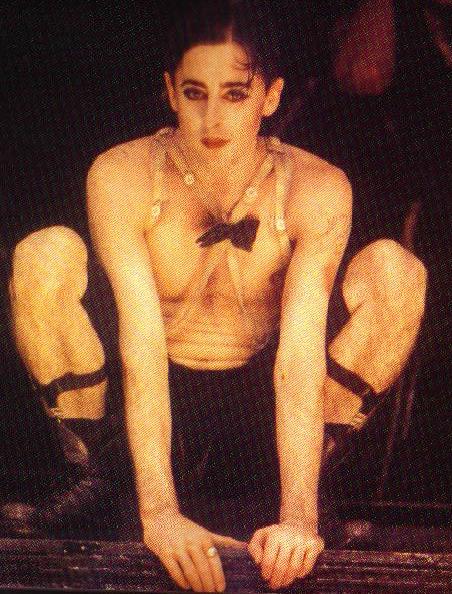
a. Mondo may be the anti-Gretchen. He seems so lovely and interesting in precisely not the way people on reality television are supposed to be. He's a tiny, shy, intense, deeply strange, Mexican American designer from Denver. Early in the season, he struggled a bit and wound up on the bottom a few times. The turning point of the season was Episode 5, where all the underdogs (including Mondo) wound up on one team, and trounced the team of previous winners led by Gretchen (the previously alluded to Team Luxe disaster). In the subsequent episode, the designers were placed in teams of two, Mondo was teamed with the cruelly bullied Michael C. In the beginning of the episode, Mondo was not pleased. He had heard from Michael C's awful teammates that he couldn't sew and was completely hopeless in every way. So, Mondo was worried about working with him, and was maybe not as nice as he could have been. But Mondo quickly realized that there was nothing wrong with Michael C., that he was hard working and nice, so Mondo apologized for his behavior (which really wasn't that awful). His apology impressed me because it seemed genuine and he didn't make a big fuss or congratulate himself or weep. He just told Michael, "I was being a jerk. I'm sorry. I was wrong." Mondo is such an odd little duck. He dresses flamboyantly (clearly basing many of his fashion choices on the Donmar Warehouse version of the Emcee in Cabaret), but his personality is not. He's quiet, intense, and a very skilled and smart perfectionist. I also love that in a flamboyant industry, working in a room filled with gay artistic types, Mondo is still a total fucking weirdo, and I say that with nothing but love and adoration.
b.This is where things start getting really freaking obvious to me. Mondo is a real find. His talent truly became apparent in the Jackie Kennedy challenge. He managed to hit that difficult to find Project Runway sweet spot: i.e. embracing the challenge fully, while not losing one’s own vision and aesthetic. This is incredibly difficult to do, and cannot be done consistently unless one both has confidence in one’s own voice, and the technical chops to realize it. His interpretation of the challenge was thoughtful and whimsical.
From that point on, Mondo started winning challenge after challenge. His clothes are beautifully constructed and tailored, combining colors and prints in riotous and exciting combinations that work and don’t look much like anyone else’s. I loved Mondo’s runway show. He utilized a Dia de los Muertos theme to great effect and I would possibly commit crimes to acquire some of his pieces (the leggings! I could die!).
4.Out of the eight seasons of Runway, there have been two winners and maybe one or two finalists whose work is truly special.Season 1 winner, Jay McCarroll, who may be the only winner in the history of reality television that after making lots of noise about wanting to work outside of corporate America, actually turned down the money rather than compromise his ideals and accept the strings that came with the 100k. It's nice to see that he's finally getting his act together and is showing, because he is very gifted. And Christian Siriano, who I found to be a little personally insufferable with his exaggerated bitchy manner and catch phrases, is really, really talented. He continuously demonstrated, that in this forum, technique counts. He was the first to admit that he had a huge leg up on the competition because he was able to sew very, very quickly. He was able to construct lovely, imaginative and complicated clothing in the time allowed for challenges, thus enabling him to make some extraordinary pieces. I really believe in technique in all art forms, it frees you up to do whatever you want to do, and Siriano was a great example of that. And then there were the winners that are, you know, fine, but not so super thrilling. Chloe Dao, Leanne and Seth Aaron seem to fall into that category. The previously mentioned Jeffrey had that one dress in his final collection that everyone remembers and was madly in love with. In other words, the judges over all did an okay job. I didn't always 100% agree, but their decisions were understandable. For example, the year Chloe won, I didn't think she was the most talented, but Santino and Daniel Vosovic both kind of choked. Which brings us back to this year's judging.
5. This is where they completely alienated me (and every other fucking person in the world seemingly). The three regular judges (Heidi Klum, Michael Kors and Nina Garcia) were joined by guest judge Jessica Simpson (who was far more articulate than expected). The four were divided evenly down the middle. Heidi and JSimp were in the pro-Mondo camp while Kors and Garcia (inexplicably) voted for Gretchen. What we saw of the deliberation was appalling. Michael Kors has lost every shred of credibility. He kept insisting the Gretchen was very "now" because hers were the sorts of clothing one is seeing in department stores. I mean, what the fucking fuck? Doesn't that mean, her stuff is, like, behind the curve? Also pointed out by JSimp and Heidi: if you're not 5'10" and dead skinny, Gretchen's clothes are unwearable. And am I wrong in thinking that when JSimp pointed out how all all of Gretchen's clothes are all so loose and baggy, the subtext was, "Um, I have boobs. Me and every other woman with boobs will look ludicrous and very, very pregnant in these hideous schmattas." And then they (Kors and Garcia) shut JSimp up by saying "read a magazine". Heidi at this point was basically raving, saying (I'm paraphrasing), "What is the point of this competition? Shouldn't we be rewarding creativity and innovation? Mondo's work is different and unique. What are you thinking? Gretchen's clothes need models and aggressive styling to look half way decent." For which I will love her forever. For going to bat for creativity and innovation in the face of Kors and Garcia literally sneering at her. And then Michael Kors intimated something that is truly outrageous. He said in response to Heidi's very valid points about rewarding talent, that there are designers in the world like John Galliano and there are designers in the world like, him, Michael Kors. He then intimated that the designers like Michael Kors are the ones to back, because more women wear their clothes. At which point my jaw simply dropped. If any of my non-fashion literate readers have made it this far, let me explain. Michael Kors is very talented. He makes nice, wearable, American sportswear. If you need a dress for your office party or some nice vacation wear, he's your man.
Which is fine, and yes, some version of what Michael Kors does is how most women dress day to day. John Galliano's spring men's collection was completely inspired by Charlie Chaplin. Below, is a lovely 40s inspired day dress (the model is styled to look exactly like Vivian Leigh). I decided to compare day dress to day dress, because if we were to get into evening wear, it would just be, um, unkind to Mr. Kors.
Michael Kors is talented. But, John Galliano is a stone cold genius, the likes of which come around at the rate of, say one or two every twenty five years. If we're lucky. It's kind of like if Dick Wolf said his work was more worthy of praise than Martin Scorcese's because more people watch Law & Order every day. This argument went on and on back and forth, with no one budging. One of the most contentious pieces was Mondo's polka dot dress. Neither Michael or Nina liked it when they saw it in the semi-finals, but he put it in his collection anyway (Heidi loved it). I sort of think they were just pissed off that he ignored them. I also think it's interesting that two weeks down the road, I can remember nearly all of Mondo's collection and all I can remember about Gretchen's is a sea of droopy brown.
And, what, you ask does Uncle Tim have to say about all this? Here is his bitchy take:
6. So what's my takeaway from all this? Why have I spent nearly two freaking weeks thinking about this? Here's why. I think the issues at play here go much deeper than an unfortunate decision on a reality television show, and as unlikable as she may be, none of it is really Gretchen's fault. When we sweep aside personalities and producers and hurt feelings, what we are looking at is a major divide in the issue of aesthetics, and more specifically, American aesthetics, and on an even deeper level, what it means to be American. Since the end of the Great War, the invention of what we call sportswear revolutionized the way people dress. There is much confusion about the name, but it refers to being a spectator, rather than one of the athletes, i.e. what you would wear to watch the Yale-Harvard game, rather than what is worn on the field. Coco Chanel famously invented the modern idea of casual fashion, but it was a group of Americans who truly ran with it. In the 30s, Claire McCardell essentially invented the American sportswear industry, making her the most important designer no one has ever heard of. Katherine Hepburn elegantly lounging around (heterosexually) in trousers, didn't hurt the cause either. After WWII, simple WASPy elegance was what classy women were meant to aspire to. The two women who most famously embody casual American elegance were Grace Kelly and Jacqueline Kennedy. Interestingly, neither were WASPs. After the tumultuous 60s ended, there was a reversion to this WASP ideal, as evinced most famously in the sportswear of Ralph Lauren and Calvin Klein, both Jews from the Bronx. Throughout much of the past 35 years or so, this was what was usually meant in America when one referred to "good taste". Simple, chic, small breasted, white. Let me get back to Mondo. When discussing his collection both Nina and Michael touched on the question of "taste". Gretchen has such good taste. Mondo is over the top and loud and costume-y. Heidi thank fucking god disagreed and pointed out (as some length) the different ways one could wear and style many of the pieces Mondo showed. Are his clothes "good taste" in the sense that Michael Kors's clothes are tasteful (see: beige dress above)? No. He is very clear about that fact that he is inspired by many influences, including Mexican folk culture. I mean, are we really having this argument in 2010? What is good taste? For some reason this phrase is starting to sound somewhat assaultive to me. Point of fact: look at fucking Gretchen's collection. Anyone not tall, anyone not flat-chested would find all of it unwearable. Not so with Mondo's collection. If there are two words that should be banished from American fashion they are "ethnic" and "exotic", because what is usually meant by both is "not Anglo". It's just so tiresome and insulting at this point. Chanel Iman isn't "exotic", she's a teenager from California fer chrissakes. And what was so appalling about hearing this nonsense spouting out of the mouths of Michael Kors and Nina Garcia is that they should know better, they're hardcore fashion pros. European designers have been foisting their whimsical, colorful and creative garments on the world (for good and ill) for decades, if not centuries. Americans have traditionally been so much more tentative, focusing on sportswear and averages and good taste. We need an American Vivienne Westwood or Alexander McQueen or (lord help us) Karl Lagerfeld. The road to this kind of aesthetic freedom is not via the likes of Gretchen. Choosing her over Mondo was indefensible and cowardly and conservative in a way any creative industry should be ashamed of.
Back in 6th grade, my somewhat extraordinary teacher Mr. Harrison took our whole class to see a double feature of horror movies one Saturday in October, 1980. The first feature was The Legacy (I think), as all I remember was a big fancy house, and the scene where someone got trapped and killed in an indoor swimming pool, as I found that really chilling. The second film was John Carpenter's Halloween. Let's leave aside discussion of the appropriateness of taking a bunch of little kids to a slasher movie with added bonus toplessness. What matters is the movie terrified me. After seeing it, I would lay awake in bed, thinking if I made the slightest move, something would see, and then kill me.
I've always been a big fan of exposition spewing Brits in Horror movies, from Lionel Atwill in Doctor X to Rupert Giles in Buffy, they never fail to delight me, and I think Donald Pleasance does a bang up job as the expositing shrink who runs around trying to lock up blank faced, scary, unstoppable Michael Myers. But he's not the point, the scary killer is. And there's something about the real world setting and the seeming plausibility of it (not to mention the proximity to where I grew up of the wonderfully named Creedmore Hospital - home to the local criminally insane), made this film particularly horrifying. But, I loved it.
I've already blogged about the excellent spook walk in Sleepy Hollow, and that was pretty much as scary as it got this Halloween (unless you include the truly frightening amount of gin the bartender at The Player's Club poured into our cocktails). My Major Domo and I hit as many events as we reasonably could this weekend, and you can read about our adventures here. We watched a Phantasmagorical magic lantern show, and then because seemingly me and my Major Domo control the world, three days later we saw Terry Borton, the magic lanternist we had just seen perform, on TCM's excellent documentary Moguls & Movie Stars! We are total outliers! On actual Halloween we inadvertently walked right into the Williamsburg Halloween parade as we were on our way to DM Theatrics production of Plan 9 From Outer Space. All delightful, but not exactly scary.
Mr. Harrison was an awfully unusual teacher. He was a former police officer who won the lottery and became a grade school teacher, just because he wanted to. He loved horror and magic and history and dressing up. I think, unlike my brother, I was often pretty lucky in the teachers I wound up with. He used to dress up as a wizard and perform magic tricks. He let our class hang out in our classroom during lunch and play poker. He let me write a paper on Queen Elizabeth I from the POV of a fly on her wall (literally). Sadly, he died of a heart attack two thirds of the way through the school year. To be honest, I have no memory of who replaced him (this was when all my teachers were dying of heart attacks - something like three in one year).
I also decided to celebrate this Halloween season by reading the wonderful Octavia E. Butler's last novel, Fledgling. It was an interesting take on the vampire mythos, as unconventional as possible. The terror in it came from the deep malignancy of racism and hatred, not from blood sucking fiends. She also brings up a bunch of disquieting questions about relationships and free will that are never resolved - as they shouldn't be, as with any real question, there are no satisfying answers. The vampires in her book live in voluntary symbiotic relationships with humans, from whom they must feed, in order to live. The vampires have some kind of venom which, over time, binds the human to the vampire. So, if the human is separated from his (or her) vampire they will die. If something happens to the vampire's human, they experience terrible, crippling grief. Each vampire needs several humans in order to survive, so they form little de facto families. Reading this book in conjunction with Butler's earlier book, Kindred, is fascinating, as it's the best novel about slavery in America I've ever read. He writing about this strange, unequal symbiotic relationship is riveting.
Now, as the season of horror ends, I'm moving on and reading Helter Skelter. It never ends.
I am a writer, director & illustrator living in Brooklyn. I have drawn many pictures, written many plays, one of which, Antarctica, has been published as a part of the Plays & Playwrights 2008 anthology. Much of my illustration and art can be viewed here: http://cavigliascabinet.tumblr.com
The vast majority of the images in this blog have been created by and are owned by me. If you would like post any of them on your site or for any other purpose, please contact me via the comments or via facebook (link to my profile is above). Thanks and enjoy.

 American's aren't terribly comfortable with the concept of aging or death. Wealthy women pump chemicals into their faces in attempts to preserve the dewy skin of youth, but the practice backfires more often than not, lending these unhappy, deluded souls the look of well preserved corpses laid out for burial. Old people are encouraged to live in ghettos called "retirement communities", where the only people required to deal with them are paid care givers, and each other.
 Our neighbors to the south celebrate death with great and storied pageantry. Día de los Muertos celebrates those one has loved and lost to the aether, one prays and eats and celebrates. It is a fitting holiday for the world's most popular death cult, Catholicism. It is this holiday that Mexican illustrator and artist, José Guadalupe Posada, is most deeply associated. His images of skeletons are justly iconic, but they really were a tiny fragment of his work. Born in 1852, he spent the bulk of his working life in Mexico City, drawing political broadsides and illustrating an amazing array of chapbooks. Interestingly, his drawings of skeletons weren't really intended to celebrate Día de los Muertos at all. The iconic La Calavera Catrina (the skinny lady in the hat pictured above) was drawn to mock the rich, saying that no matter how lovely and expensive your clothes, you too, will one day be dust and ashes like the rest of us.
 A few years ago, I was smart enough to pick up a copy of Posada: Illustrator of Chapbooks. In it, are dozens of his penny chapbook illustrations. It's remarkable that so many have survived as they were considered to be pretty much disposable at the time of their publication, and the quality of the paper is terrible. Luckily, the company that produced them kept excellent archives which were lovingly cared for by the owner's descendants. Also, Posada was a wonderful artist and people aren't completely stupid. Many people held on to them. Like any jobbing illustrator, he drew many, many subjects, but they are all identifiable as his work.
 Posada died, like many illustrators of the past century, penniless and nearly forgotten. Unsurprisingly, Diego Rivera was one of the people who called attention his work long after Posada's death. His satirical edge, which is palpable in all his work, even in his illustrations for children's stories, fits in so well with the modern sensibility. Unlike with many contemporaries in England and America whose work seems cloying or dated, his does not. Posada is more akin to near contemporary, Thomas Nast, whose work was even more overtly political, but was protected by the First Amendment, a luxury Posada did not possess.




 Posts