Sunday, May 22, 2011

Arthur Rackham: Peter Pan in Kensington Gardens


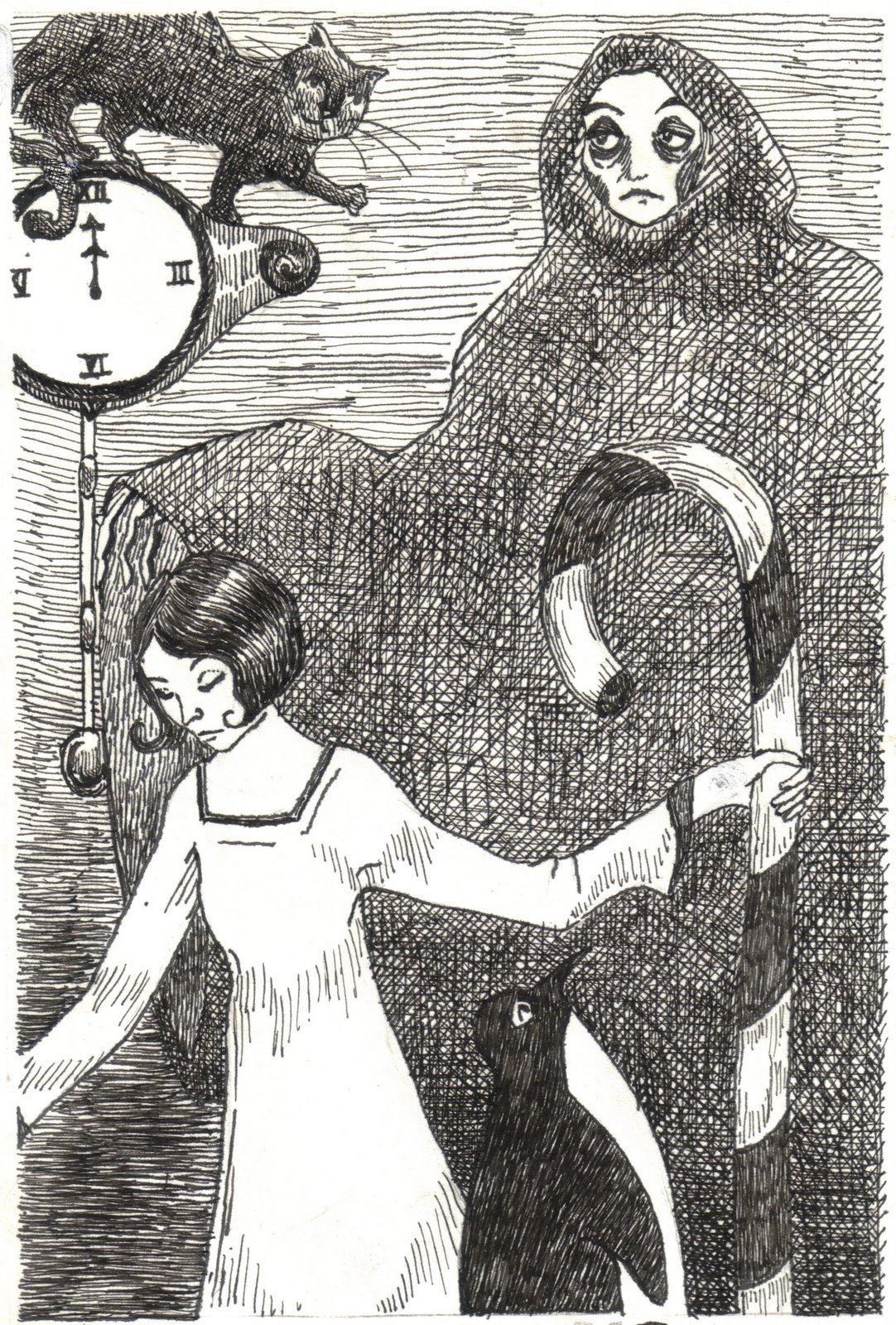
Arthur Rackham is one of the acknowledged geniuses of the Golden Age of illustration, and his pictures for Peter Pan in Kensington Gardens have long been some of my favorites.

To my absolute delight (and hopefully yours), I learned today via the always wonderful BibliOdyssey that all fifty of his illustrations are now available online via the Harvard University Library.


Saturday, May 21, 2011

How Exene Cervenka Saved My Life

Last weekend, my inamorato and I sat down to watch the 1986 documentary X: The Unheard Music which I hadn't seen in well over twenty years. Back when I was a deeply alienated teenager, I saw it many, many times.

It was the weirdest thing. Aside from how much I love the band X, it was just like stepping into a time machine to the eighties. Let me just say right up front that few things are weirder and more off-putting to me than 80s nostalgia. It must have been how lots of people viewed the 70s nostalgia of the 90s, i.e. just baffling. The 80s were kind of the worst in a way, not miles away from living in these United States under Bush II. I think most people have forgotten or never knew.

It was the time of Iran-Contra, the first implementation of trickle-down economics, ketchup is a vegetable (when feeding children and the poor - so often the same thing) and the country, as whole seemed and felt culturally dead. In other words, a fine breeding ground for punk.

Exene Cervenka moved from Florida to Los Angeles in 1976 and formed X with John Doe (her soon to be husband whom she had met at a poetry workshop), Billy Zoom and D.J Bonebreak a year later. Their first four albums are all just great, all produced by Ray Manzarek from The Doors, and I had them all and played them again and again. My favorite has always been Under A Big Black Sun, their third.

Back in high school, I didn't have anywhere near the kind of money most of my classmates did. I mean, I couldn't compete with the mean little capitalist drones who sat in bio class with me, so eventually, and relievedly, I stopped trying. I wore clothes from thrift stores and yard sales (and there was some great stuff back then, believe me), my Mom's old clothes from up in the attic and my Dad's narrow lapeled suit jackets from the late 50s. I mostly stopped listening to Madonna and Duran Duran and began listening to stuff like X and The Cramps and The Replacements. Those first few REM albums and The B-52s and The Cure and The Velvet Underground and the (early) Clash records. And I began picking through my Mom's large and varied collection of LPs, stocked with folk and country and various oddities of all sorts.

Exene is a poet and a rock star and an artist right down to her bones and I worshipped her. I used to make all kinds of collages, and watching The Unheard Music, I wonder if I first started gluing stiff to paper because I saw her doing so in the film. Maybe. You can see at right a page from a more than 20 year old notebook. I don't remember where I found that picture of Exene. From Interview Magazine maybe? Way back in the early 90s she collaborated on a book called Just Another War about the first Gulf War. Henry Rollins published it on his press and I saw her on her book tour in '92. I was so thrilled to see her.

In some ways I feel she is the last of the true believers. She still writes and sings and wears thrift store clothes. She has a son in his early 20s who she had with ex-husband Viggo Mortensen (the amount of street cred he garnered when I found out he had been married to Exene for ten years is pretty much incalculable) . I just read she's been diagnosed with MS, which is just heartbreaking, and is likely why I haven't hear much from her recently.

I realize I've been writing a lot about people who have a very particular LA folk aesthetic. If I was to classify it, I would say it's a mix of old time Hollywood, punk rock, Mexican Folk Art and The Great American West. X's aesthetic falls somewhere in this too. I can't remember off hand if they are name checked in Weetzie Bat, but I think they might be. I'm a New York girl through and through, but there's something about the myth of California that's always appealed to me. When I was growing up in suburban NY, it saved me to know there were other places out there even if they were fictional: Narnia, Middle Earth, Old Hollywood, whatever. It was mysterious and glamorous and unattainable.

So, yeah, I don't know. I don't know if Exene Cervenka actually saved my life. But sometimes it sure as hell felt like it.

Photo: Jim Jocoy, We're Desperate

Friday, May 20, 2011

SPENT: The Game; or I miss the Connor Family

"This is the game that moves as you play" - The Have Nots, X
This is another entry in my "I don't really play video games but" series.

Early this year, the Urban Ministries of Durham collaborated with an advertising agency on a pretty amazing project. They've put together a video game called Spent that mimics what it's like to negotiate the world when you have had all your middle class safety nets taken away and you are starting from zero. You have no savings and you are an unemployed single parent.

Your first task is to find a job. The first thing I did was try to get a temp job, during which, I promptly (and expectedly) failed the typing test. This has happened before in a much more real life and humiliating setting. So I got a job in a restaurant and had to buy the damn uniform. I opted out of their health insurance plan as I could not afford the premiums. The game says "Better not get sick!". Tell me about it. Fuck you, game.

And the game goes on. Rents are raised unexpectedly. Things go wrong. You get sick. All of this costs money and it inevitably snowballs. You have to make awful choices, like if you are running out of food money, do you take the ten bucks your kid's grandma sent him? I ran out of money on day 6 the first time I played. The game gives the option of "asking a friend for money" via facebook. I didn't try this. Also, in real life, when you are poor, most of the people you know are also going to be poor. Also, no one likes to ask their friends for money.

Being poor is really, really expensive, you see.

Here's the thing, and I'm always shocked how the privileged of this world aren't aware of it (and, really, I'm one of them. But I had the incredibly illuminating early learning experience of growing up around people who were far, far more privileged - for the most part- than I was). This is the deal: if you are a white, abled, middle class/upper middle class person, all you have to do is not fuck up. And then everything will be more or less okay. Of course, awful things can happen to anyone - disease, tragedy, what have you. None of us are immune. But a safety net helps greatly. If you are working class or poor, really, everything has to go right. You have to be smart and lucky and work very hard. To transcend one's milieu, you have to be special in one way or another. If you are rich, you can be kind of average and not work that hard and maybe you won't have the best life ever, but nothing truly disastrous will occur either.

And if you are a poor person, and have bad luck, you are going to be royally screwed. Spent demonstrates this tersely and clearly.

The class based nastiness in our culture seems to be going through a really bad phase. Sneering at poor people seems to have become a national past time. A co-worker this week is going to a "White Trash Party". Which, as far as I can tell, is a bunch of rich people making fun of a bunch of poor people. This is really complicated stuff, entwined with all sorts of issues of race and gender (non-white people and women are more likely to be poor), and lord knows, I don't have any answers. But maybe the first thing we need to do, is to have maybe just a tiny bit of empathy.

Television seems to be going through a particularly vile patch of worthless rich people worship (and much as I love Top Chef: Bravo, will you please just shut the fuck up and go away please?). Occasionally you see a poor or working class person who is presented for the purposes of mockery. There was a pretty great piece up at The Awl the other day about a truly repulsive new TV show called Repo Games which is worth a look. As mentioned here before, Jennifer L. Ponzer's book, Reality Bites Back is pretty much a must read at this point for anyone who has even a passing interest in what we watch. She points out, in great detail, how these shows reinforce a truly regressive version of the status quo. One in which poor people and women are to be ridiculed and to be Paris Hilton's fake BFF is something that one humiliates oneself to be.

Empathy happens when people acknowledge that other people are, like, human. And have exactly the same sorts of feelings they have. It's the opposite of objectification, that often misunderstood concept that strips people of their humanity. Which brings me to a piece in this week's New York Magazine, written by Roseanne about her show (Read it! Seriously, just read it. God I love her. She writes as only someone with nothing else to lose writes). I don't think you see enough about Roseanne when you see articles about remarkable and groundbreaking television. I'm not sure why that is. Maybe because it was a sitcom about a family, the most standard television format imaginable, it gets looked over. Maybe it's more insidious. I don't know. I miss the Connor family, and loved them as did the millions of other Americans who made the show number one in the ratings for half a decade. The Joss Whedon penned "Brain Dead Poet's Society" makes me cry just thinking about it, in which Darlene reads her poem in which she writes "too short to be quarterback, too plain to be queen".

So what I'm saying is, it would be nice if there were some working class Americans on TV who weren't the objects of ridicule. And I'm no Socialist, but this ultra-Capitalism we seem to be embracing is so culturally unhealthy and just gross. So, obviously, this grim little video game isn't going to do much in the face of all those "Housewives (TM)", but it's so bracing after a media diet that can seem like the equivalent of having frosting for dinner. Sweet, but so, so sick-making.

lluminating Fashion: The Morgan Library

I often think about the semiotics of Fashion and Clothing (not exactly the same thing), so I'm champing at the bit to see Illuminating Fashion: Dress in the Art of Medieval France and the Netherlands, an exhibit at The Morgan Library which opens today. In it, they purport to chart the evolution of fashion in (of course) France during the Medieval Era through illuminated manuscript illustrations.

So rarely do so many of my obsessions come together in one exhibition! Illuminated manuscripts are some of the earliest European illustrated books, mostly rendered in egg tempera, one of the hardiest mediums known to man. The surviving pictures are still as bright and fresh as they day they were painted.

For many hundreds of years, one was able to tell precisely where a person fell on the social scale just by glancing at them. Strict sumptuary laws prevented any but the entrenched nobility from wearing certain fabrics and colors and styles. It wasn't until the rise of the prosperous merchant class in the Renaissance that these laws began to be stripped away. Nearly all of what we know about what people wore in pre-modern times is from art as textiles rarely survive so long. Because of this, our understanding of undergarments is minimal. Fashions moved slowly in a time before travel was common and before Mr. Gutenberg invented his remarkable press. Great world events influenced dress remarkably - the Crusades and the opening of the East brought silks and velvets and brocade to Europe, and the shapes of clothing changed as well. The corset became de rigueur in the 14th century. So, needless to say, I'm looking forward to seeing what the curators of this exhibition have put together.

For information about visiting The Morgan Library and Museum, go here. The exhibition runs from today through September 14th.

Wednesday, May 18, 2011

Lori Nix: Unnatural History and Other Worlds

In talking about photography, I most often say that I like pictures of people. And mostly, the same goes for paintings. But, as in most things, there are oftentimes exceptions and the photographs of Lori Nix are a huge one. I was first introduced to her work via a facebook link posted by the always interesting Artistic Director of Art House. I was instantly intrigued and spent a lot of time with them.


There aren't any people in them at all, and Nix has said in interviews that one of her great influences are the Hudson River School of landscape painters and, in a way, it shows. When I first saw her photographs I couldn't quite figure out what I was looking at. They were from her series "The City", in which we see strange, long abandoned urban scenes in which trees and other foliage have grown back. I didn't understand where they were taken, or how she found these remarkable scenes to photograph.


Lori Nix's wonderful settings aren't found, they are made. She creates them herself, on tabletops. She then lights them and doesn't use any digital manipulation at all. They are perfect and melancholy and exquisite. There are landscapes and interiors and insects. She shares some of my personal obsessions, as do many of the artists I feature here - the conflict between the natural world and the structures of men; museums and toy theaters of all sorts.


I both want to know how she makes everything and I don't. Am I the only one who wants her to branch out into animation? Maybe I'm wrong, maybe the power of her images comes from their silence and stillness. Qualities rare indeed in our noisy and over-stimulated world.

All photographs are the property of Lori Nix. If you are interested in purchasing her work, contact ClampArt. (Pssst: Wealthy admirers, I have birthday coming up, you know)

Monday, May 16, 2011

The Great and Wonderful L. Frank Baum

Yesterday, as reported elsewhere, the great and wonderful L.Frank Baum would have been 155 years old. 111 years ago, Mr. Baum wrote The Wonderful Wizard of Oz. He devised it because he thought the world needed an American fairy tale, one for the modern age, for modern children, that would leave out both the horrors and moralizing of Grimm. As we are all aware, he succeeded marvelously. He had the great instincts of a true showman, and he pleased his audiences beyond measure. So much so, thirteen sequels followed.

It's always seemed kind of unfortunate to me that most people, if they have read any of his books, have only read the first Oz book, the one on which the movie is based, as I think it is one of the weakest. Compared to the amazing flights of imagination in (my favorite) Ozma of Oz, or in The Patchwork Girl of Oz for example, it seems a little bereft of whimsey. I've mentioned Ozma of Oz elsewhere in writing about modern steampunk, as Mr. Baum presents one of the very fist literary robots.

I don't know if there is another author who has ever been as attuned to what children want as Baum was. Something about his stories goes right to the center of childhood itself. I think it has so much to do with friendship and animals and the fact that nearly everything talks. If there's one dream shared by many, many children it's that one's toys and pets would talk back. In Baum's invented universe, they most often do. One of my favorite bits of retconning is in (I think) The Lost Princess of Oz, when all the animals ask Toto why he didn't begin talking like all the other animals from our world do upon entering the Fairy Land of Oz, and he says he just didn't feel like it.

Baum reportedly wanted to cease writing Oz books, as he had other stories to tell, so he kept on introducing elements such as the spell Glinda cast that would make Oz appear to outsiders as just a continuation of the Great Sandy Waste that surrounds it. All of this is documented in his author's notes at the beginning of each volume. Inevitably, he will end a book with Oz being cut off from us (and thus, Baum, The Royal Historian of Oz, will be unable to write any more installments). He also, inevitably, reports receiving a letter from a little girl in which she asks "What about wireless?", and his writing about Oz continues, as it did until his death in 1919.

His influence upon my life is incalculable. We had a full set of the Oz books when I was growing up and I read them all repeatedly. W.W. Denslow, who illustrated the first book, is considered one of the great illustrators of the Golden Age. But, John R. Neill, who illustrated the other thirteen books has always been more to my taste. I grew up trying to draw as much like him as I could, and his massive influence is still visible all over my work. I was a strange and lonely child, likely with an undiagnosed case of OCD, prone to list making of all sorts (I swear, I spent at least half my childhood alphabetizing). At one point, I went through all of Baum's Oz books and made a list of all the characters. I (of course) alphabetized them and then drew each one. I also remember drawing each of Princess Langwidere's thirty heads.

I haven't reread them all in years and years. I think it may be time to do so again. I will, of course, share my findings here.


Sunday, May 15, 2011

Sympathy For Lady Vengeance

Park Chan-wook's Sympathy For Lady Vengeance (2005), the third film in his Revenge Trilogy, is a strange and beautiful thing. Vengeance, so common in movies, is unsympathetic and awful in real life, but I think its existence in the realms of fiction provides some sort of catharsis for people in their lives of quiet and ordinary desperation.

Lady Vengeance stars Lee Young Ae as Lee Geum-ja, a woman who has been wrongly convicted of the murder of a child who seeks revenge on the real murderer, who has ruined her life, and the lives of the families of the children he has killed. The story is slowly pieced together through stunning and often hilarious imagery. We watch flashbacks to Geum-ja's time in jail as she garners a reputation for extreme kindness as she helps her fellow prisoners, gaining their trust and putting them in her debt as she poisons a brutal prison bully and even donates a kidney. Upon her release, she calls in the favors she is owed - she needs money, a place to stay, a job, weapons. She has dropped the sweet facade she manufactured and is a creature of pain bent on revenge. We see her dreams of revenge and they are shocking and surreal.

One can't help but compare Park's film to the Quentin Tarantino epic, Kill Bill, as they were filmed at about the same time. Both are about a young woman who is seeking bloody revenge on an older male authority figure and her search for a daughter she has never met. But where Tarantino's film (which I enjoyed) is nearly entirely a complex and magnificent exercise in genre, Park's is something much stranger. There's a nearly operatic sense of grief and loss in it, and where Tarantino's film ends with what must be called a happy ending as Uma Thurman happily drives into the sunset with her daughter, in Park's film there are no such simple endings. Geum-ja knows she's turned into a monster and her daughter has been adopted by an Australian couple who are the only family she knows.

Not to say that many of the pleasures of this film aren't ones dripping with a pop sensibility, because they are. But bubbling underneath it is terrible loss, a strange melancholy. It's lovely, really.

Saturday, May 14, 2011

Tentacle Pot Pie

Learning how to cook more things has been on my agenda for quite some time. I really enjoy food and my culinary repertoire is somewhat limited, so I've been on the lookout for recipes I can try.

I've said elsewhere that I have no trouble eating meat, but I will not eat anything with tentacles. Maybe I spoke too soon!

I found this.


The Tentacle Pot Pie.

I'm entranced!

(photo and recipe via NotMartha.org and Megan Reardon)

Friday, May 13, 2011

Alfred Kubin: Symbolist Artist and Proto-Surrealist

Alfred Kubin, born in 1877, was a strange, reclusive and emotionally fragile artist and illustrator. When he was about 20, he attempted suicide on his mother's grave and suffered a series of breakdowns. It was around this time that he discovered the work of Odilon Redon, Edvard Munch and Max Klinger and was profoundly influenced by them. Previously apprenticed to a successful landscape photographer, he moved into working in mostly pen and ink and lithography and began traveling in German avant-gard circles.

His work is grotesque and nightmarish, and feels profoundly Freudian (lots of scary vaginas). One the war started he pretty much became a recluse, and remained one for the rest of his life, holing up in a 12th century castle in Austria. His work was declared "degenerate" and "decadent" by the Nazis (if one wishes to be strictly truthful, he was both. The question is really whether you have a problem with it or not), but they pretty much left him alone. Unsurprisingly, he illustrated work by Poe, E.T.A. Hoffman and Dostoyevsky.


He also wrote a couple of strange dystopian novels, all of which are sadly out of print in English (unless you have a Kindle!). It's all terribly evocative. I decided to feature him here because I found that once I started looking at his pictures, I simply could not get them out of my head. I haven't read his famous novel, The Other Side, but I've heard very good things. One wonders what went on in his mind as he worked alone in his castle. One looks at his work and shudders.


Thursday, May 12, 2011

Rebecca West: The Fountain Overflows

Rebecca West is one of the seemingly limitless number of people who was colossally famous in the 20th century and now seems to be nearly forgotten. As you can see, she was a big enough deal to wind up as the cover story of Time Magazine in 1947. She had a truly remarkable life, living until she was 90. She was a world class journalist, covering the Nuremberg Trials for The New Yorker, a novelist, a Feminist (she's name checked in Virginia Woolf's a Room of One's Own - I mean, does it get any better than that? Chapter Two, if you're interested), political crank, an intellectual who began her adult life as an actress (her real name was Cicely Fairfield, Rebecca West was the stage name she chose, from Ibsen's Rosmersholm) and all around fascinating person.

Her personal life was equally interesting and varied. She had a decade long affair with the much older H.G. Wells and had a son with him while Wells was still married to somebody else. She feuded with her son their whole lives, one of his grievances being she pretended, in his early years, to be his "aunt". I first saw her when she served as one of the aged talking heads in Warren Beatty's John Reed biopic, Reds.

I'll likely revisit West again on this blog as I read my way through her oeuvre, but here I want to talk about her 1957 semi-autobiographical novel, The Fountain Overflows. I first read it a few years ago and I loved it so much I didn't trust myself. What I mean by that is, I loved it to such a degree I knew I was blinded as to its objective literary worth. I remember knowing after I finished the first chapter, that unless she did something very stupid indeed, this was likely to become one of my all-time favorites. Needless to say, she did nothing stupid whatsoever, so one of my favorites it remains.

If you ask me what it's about, I'd answer: It's about a musical family (The Aubreys) in the first decade of the 20th century with a father who is a political journalist and a compulsive gambler, a mother who is a former concert pianist, three young daughters (one of whom, Rose, is the narrator) and a young son who is some sort of genius and is little more than a baby when the book begins. It is set in the very first years of the 20th century as the Aubrey family moves from Edinburgh to London, and the girls begin to grow up.

I realize this makes The Fountain Overflows sound like the most conventional novel, but it really isn't. If you ask me again what it's about, I would respond: It's about the difference between children and adults and childhood and adulthood, about art and what makes good art and bad art. It's about poverty and how children respond to it differently from each other. It's about women and how they function in a world in which they have very little autonomy, and about how some optimistically make do and how others flail and nearly drown. It's about what it means if one is a real artist and if one isn't. And how hard it is for each. It's about the uncanny and about how men can sometimes simultaneously knowingly destroy their own lives and unknowingly destroy the lives of those who love them. It might be the funniest and smartest book about what people are like that I've ever read.

The twins, Mary and our narrator Rose, are budding concert pianists. Their elder sister, Cordelia plays the violin, and the great tragedy of the Aubrey family is that Cordelia is a terrible musician and does not know it. This is viewed by Rose and Mary as a far worse tragedy than their poverty or their father's inability to hold onto a job. The worst of it is, though she is a competent musician, she just isn't any good. A distinction that is lost on most people, and Cordelia is a pretty little girl who looks charming when she plays, so she receives heaps of praise. This is simultaneously hilarious and awful and is one of the main threads of the story.

Their father is also both wonderful and monstrous. He's a political journalist of very great repute, who gambles and borrows money, who alienates his followers and friends, who cannot suffer fools. His children are all in awe of him and think him the most wonderful man, but there is a thread of nihilism and self-destruction that also frightens them. Near the beginning of the book, when they are all still small, he gives the children a remarkable and magical Christmas in which they receive elaborate toys he's made himself. They love hearing the stories from his childhood, and they watch as strange men come to the house and demand money from their mother for debts unpaid. There is a remarkable passage in which we find out that public opinion has swung against him, and his friends in Parliament think him mad because of a pamphlet he's written in which all the ills of the 20th century are laid out in black and white. It's full of extraordinary passages as Mr. Aubrey's MP friend shares his dismay and horror with Mrs. Aubrey - who knows nothing about politics but everything about music. She tells him that it's possible her husband is a seer because:
"'I am a musician, you know. We find that in the great composers. Much of Bach and Mozart and Beethoven is much more comprehensible than it was when it was first written, or even than it was when I was young. My teachers found Beethoven's later quartets quite baffling. That can only mean he wrote with a full knowledge of a musical universe that was still chaos while he lived.'"
There is a sequence in which Rose visits her cousin Rosamund and her mother in their shabby house and she and her mother discover them besieged by poltergeists. The ghosts or demons or spirits or whatever they are real and awful. But they are immediately and permanently dispelled once the two little girls and their mothers are finally in the same room as each other. Rose's mother, Clare, calls the supernatural a "dirty business" and is not something to be played with. Everyone in the Aubrey family can prognosticate to some degree or another, but it is not viewed as something that should be indulged, and if one does so the after-effects are never good.

Among all the remarkable set pieces in the book is a good old fashioned, Victorian murder. A school friend of the girls' mother poisons her husband and the Aubrey family wind up taking in the little girl and her aunt. The murderess's family are rich, uneducated Cockneys (while the Aubrey's are, of course, painfully over-educated upper class paupers), and West's descriptions of Aunt Lily are very funny. But what's remarkable is that while they are funny, they are neither condescending or sentimental. West manages throughout the book a combination of uncompromising truth telling and extreme kindness that I've never really encountered before. She's never, ever cruel to her characters, though many do awful things or behave badly.

It's really the oddest book. In some ways it's like the books one reads when one is a child, about a family of (mostly) girls, growing up in genteel poverty, who want to be brilliant musicians. I mean, I know that when one describes it, it sounds like a Noel Streatfeild book. And in a surface way it is like that, and I think if I had read it when I was eleven I would have loved it, too, and it's likely one of the reasons for my loving it (and I use that word literally - the things or people I love more than this book I can count on one hand). But as is so often the case when one reads very well at a young age, one misses nearly everything, and I would have loved it without understanding it - which in some ways is so much of what the book is about, as it is as much about being a girl as it is about anything. It has the shape in some ways of a very traditional sort of book written for young people. But, at its core, its a modernist masterpiece with all the pleasures of Victorian fiction. It's not a book for children, but it's very much about what it's like to be a child, and the child narrator is one of the most extraordinary voices I've read. West manages to make her sound the way children feel in their heads, rather than how they are heard by adults. It's often unclear how much time has gone by or how old the children are, it all flows seamlessly without the traditional markers used in more conventional fiction.

Also unconventional is that the book is entirely about the Aubrey family and their home. There are very few scenes which take place at school. There is no romance of a traditional sort in the book. The more I think about it, the more I think The Fountain Overflows might be an extraordinarily complicated, 400 page character study of Clare Aubrey, the girls' mother. Again, in some ways she resembles that perfect mother of our dreams, Marmee from Little Women. He love is what keeps their family from falling into irreparable chaos and misery, and her love and kindness is on offer to pretty much everybody who enters her home, or is swept up in her wake - including a discarded mistress of Mr. Aubrey's and the mistress's husband (meeting whom, causes her to reread Madame Bovary, which makes her forget to be angry at her husband). We see her through her children's eyes and they are fiercely protective of her, as they think they are tougher then she is, as their childhood was far more difficult, but like children reading a grownup novel - they miss the point a bit.

There is a thread of politics that runs through the book, but West is wise enough, or perhaps I only think she is wise as she thinks as I do, that people are more important than politics. And this is book that is about people and about art and about family. Rebecca West writes as well as anybody I've ever read, and better than nearly everyone. Her prose is so clear, so sane and so sharp. Her sentences and paragraphs are long, and like the novel itself, perfectly constructed. As she writes about the Aubrey family and their friends it's as if she's wielding a sharp paring knife, cutting deeper and deeper into the truth of who these people are. Her criticism could be vicious when she was young. Shaw said of her: "Rebecca West could handle a pen as brilliantly as ever I could and much more savagely." And here she cuts very deeply indeed, but never thoughtlessly, never unkindly.

In her author's note at the end of the book West writes:
"The main theme of the book might be said to be the way human beings look at each other inquisitively, trying to make out what is inside the opaque human frame. Piers and Clare Aubrey loved each other but never really knew how the other one thought and felt. Mary and Rose were divided from Cordelia and watched each other in irritated misapprehension, and were divided from Richard Quinn and looked at him in hope of comprehension. They were all looking for clues to understanding... But I only wrote this book, which is not to say that I am the best authority on what it means."
Whatever it means, I can say I love the Aubrey family and maybe that's enough meaning, really. West wrote two sequels, This Real Night and Cousin Rosamund, both still unfinished at her death in 1983. She apparently spent years tinkering with them and never thought them ready for publication. However, they have both been published posthumously, and they both sit on my shelf waiting to be read.