Showing posts with label Angela Carter. Show all posts

Monday, January 31, 2011

My Mother She Killed Me: An Introduction

"You think...that bad old science made the magic go away?" - Jenny Calendar, Buffy the Vampire Slayer, Season 1

I've had my reviewer's copy of My Mother She Killed Me, My Father He Ate Me sitting on my bedside table, unread, for a shamefully long time. Part of the reason for this is that I wished so badly to have something to do with it. The editor, Kate Bernheimer, runs the Fairy Tale Review (along with being a teller of stories in her own right), and it's really no one's fault but my own that I haven't yet contributed. But on to my reading.

I've just begun, truth be told, and I've decided to make dispaches along the way. This is the first. It's going to be all about front matter.

The book is dedicated to Angela Carter as it should be. She is, in some ways, mother to us all. The brilliance with which she wrote both fiction and criticism, much of it pertaining to story telling of all different varieties is very nearly unparalleled. She influenced Salman Rushdie, Margaret Atwood, Kelly Link, Marina Warner, and on and on and on. Warner, formidable novelist and critic in her own right, first met Carter in the London Vogue offices in the 70s. She writes of Carter in her indispensable book From the Beast To the Blonde: on Fairy Tales and Their Tellers:
Her humor was of the unsettling variety, that made it necessary to examine one's own received ideas. It was so very impolite, with its particular idiosyncratic feminism, its blend of the irreverent and the gothic, its dazzling linguistic intricacy and relish for imagery...It is uncomfortable to list to the iambic distych, to know you are identifying yourself as an outsider by what you say, that all the disguises in the wardrobe will never fix identity, all the voices in the repertory will not tell the complete story.
She was a subversive and an intellectual and wore both on her sleeve. She, the greatest writer of the last half of the 20th century mostly worked in the form of the fairy tale. Carter's quote from the front-piece of this collection reads:
Ours is a highly individualized culture, with great faith in the work of art as a one-off, and the artist as an original, a godlike and inspired creator of unique one-offs. But fairy tales are not like that, nor are their makers. Who first invented meatballs? In what country? Is there a definitive recipe for potato soup? Think in terms of domestic arts. "This is how I make potato soup."
In other words fairy tales live in the realm of the folk, of the collaborative, of women and fools and children and magic. I've seen a few bits of writing (supposedly very clever) recently, where people (mostly boys) examine very finely the mechanics of magic. Sometimes there is talk of what could happen, what couldn't happen, and what is real. This, of course, is very stupid indeed, as none of it is real. It's a fun parlor game to wonder how things work, but I've so often seen these sorts of writing serve as a denial or a cursory dismissal of the fictional magical or divine. It's all fiction. The ordinary workaday waiter or firefighter or coal miner could just as easily sprout wings and fly away. The realms of the literal might be more real, but I very much doubt they are more true. Literal mindedness in the face of fictional magic is the province of petty minds.

Kate Bernheimer's introduction made me tear up. It's one of the most passionate and beautifully written defenses of the form that I've read. Her mission, to gather all different kinds of writers to tell fairy tales is a magnificent thing. Along with usual suspects such as Kelly Link and Neil Gaiman who work in the form constantly, she has drafted people like Michael Cunningham and Neil LaBute who seem to be rather unlikely participants in such a project. But then one thinks of that often repeated quote of Nabakov's (which Bernheimer repeats): "All great novels are great fairy tales" and you realize that maybe these unlikely writers aren't so unlikely as they first appeared.

The forward by Gregory Maguire reads as something of a clarion call as well. It calls up the ghosts of Tolkien and Emily Dickinson and Prospero himself; Star Wars and the pre-Raphaelites and nursery rhymes and Hollywood's current little girls lost; Elsinore and Marley's chains and the leopard and his spots; Kensington Gardens and spiderwebs and the illustrations in old psalters and Bob Dylan and Sherwood Forrest. Fairy tales are held as something lesser, partly as Carter says above because there is no clear author in our great age of the individual. As Maguire quotes Hans Christian Andersen's translator: "The fairy tale belongs to the poor. I know of no fairy tale which upholds the tyrant, or takes the part of the strong against the weak. A fascist fairy tale is an absurdity."

Folk tradition is egalitarian by nature, whether they be tales of Baba Yaga or the songs sung by Woody Guthrie or Foolish Jack or The Cat in the Hat - they are subversive by nature, and they are all worth listening to.

As I read my way through this book, I'll be back with more opinions and things to say.

Wednesday, November 24, 2010

Passion Play: Fevvers and Mickey Rourke


While conducting my (ridiculously extensive) Megan Fox research for my Jennifer's Body post last week, I was intrigued - to say the least - to discover the nature of Ms. Fox's next project. It's an indie called Passion Play, directed and written by Brian Glazer and co-starring Mickey Rourke, Bill Murray and Rhys Ifans. A fine cast indeed, but that's not what grabbed my interest.

The movie is about a horn player (Rourke) in trouble with a gangster (Murray) who happens upon a sort of traveling freak show/carnival in which customers pay to look at the beauteous Ms. Fox, who has a pair of wings growing out of her back. Hm. So. Regular readers of this blog will no doubt know of what this made me think. A few months ago, I published a post in which I waxed rhapsodic about Angela Carter's novel Nights At the Circus. To recap: It's about a beautiful young woman (dubbed "The Cockney Venus"), who at one point in this picaresque telling of her life, winds up in a sort of Freak Show brothel where men pay to look at her. Oh, and she has a pair of wings sticking out of her back. I'm not saying there's any sort of plagiarism afoot, as the stories sound otherwise completely different, but it is curious.

The film premiered at the Toronto Film Festival to not terribly enthusiastic reviews. I looked at the few clips that are available, and for me the biggest problem was with Roarke. Between his boxing injuries and his perplexing plastic surgery, he almost looks as if he's wearing a poorly rendered Mickey Roarke Halloween mask. The reviews all read as if the writers really, really wanted to like it. It's an intriguing premise, but the execution leaves much to be desired, apparently. It's a sweet fable, they all say, but it has some issues with tone and garnered some bad laughs. People like Ms. Fox in the role of the winged girl, Lily, though paradoxily one or two wished the story was more about her character, rather than her just being an object of desire, or obsession for the men in the film.

Thus far, there is no set release date, which doesn't bode well. Still, I'm very curious. If it does make it to DVD, to the top of my Netflix queue it will go. Below is a clip:

Monday, July 26, 2010

Nights at the Circus & Wise Children: Angela Carter's Last, Great Novels


Maybe I should elaborate.

Angela Carter's final two novels before her early death from lung cancer in 1992 are also, for my (pretend) money, the two greatest show biz novels ever written. I started reading Nights at the Circus on the subway ride from my parents house to Windsor Terrace on the very first day of my taking up residency in Brooklyn. For some reason, this feels deeply symbolic to me in ways that feel profound, but difficult to articulate. Why is it that one's life tends to change in so many ways at once? I spent a great deal of time my first winter in the wilds of Brooklyn wondering what I was doing there and I read an awful lot, but it started with this one book.

Nights at the Circus is written in three parts (or acts, or rings if you like). So many novels about theater, or show business wind up being a little like the novel equivalent of one of those HBO bio pics. Don't misunderstand me, I love HBO bio pics - but I mean they tend to be I guess really linear and about the subject matter in a way that really great literature rarely is. Nights at the Circus is a truly great book that most people I know have never read. Which just kills me.

It begins at the cusp of the 20th century in London. Jack, an American reporter sits in Sophie Fevver's dressing room as she tells him her extraordinary life story. Fevvers is the toast of Europe, the greatest aerialist alive - billed as "The Cockney Venus" she has two wings on her back, and may be part swan, part clockwork or a complete hoax. Her tag line is , "Is she fact or is she fiction?" and it's really the question of the book. In all Angela Carter's books and stories, people are always changeable, nothing is carved in stone. Women turn into tigers, men wake up women, you name it. But in her last two great novels, this mutability, her obsession with facades and performance is self-consciously theatrical. She achieves the tone in Circus of a gritty, music hall, magic realism, burlesque that is quite literally completely unlike anything else I've ever read. Little Fevvers was found as an infant on the doorstep of a London brothel just beginning to sprout little tufts of down on her shoulder blades ("Looks like the little thing is going to sprout fevvers!"), was raised there, eventually finding herself in a freak brothel run by an evil, tiny dried up puppet of a woman (who may actually be a puppet). The old whore who raised Fevvers may be an anarchist (the kind that blows things up), and the reporter wonders if Fevvers is actually a man, and if anything he is told is true.

The second act is set in St Petersburg as Fevvers has been engaged by Colonel Kearney's Circus for their Grand Imperial Tour of the Russias and Japan (to be followed by their Great Democratic Tour of the United States). Jack has signed on as a clown, and there is lots of truly disquieting drunken clown mayhem and strange self loathing monologues by the monstrous Buffo the Great who turns the American into "The Human Chicken". There is the ape act, with the drunken Professor who beats his poor, long suffering mistress (who used to work for a crooked spiritualist, playing dead children), the Abyssinian Princess (ahem.) who tames tigers, a high wire act that loathes Fevvers (understandably), a love sick strongman named Samson. And Colonel Kearney himself, the ringmaster and circus owner, a huckster from Kentucky with a remarkable pig named Sybil. The story telling is strange, meandering, and baroque. The third act is set in Siberia, and here it takes a turn into the truly bizarre and nearly mystical. Circus impresarios, murderesses, would-be rapists, amnesia, winged women, tigers caught in mirrors, a Russian Grand Duke, explosions, freaks, whores, truly educated apes. Lots of it is funny, some extremely unsettling. The whole thing is just gorgeous. Angela Carter books aren't about plots, hers are usually absurd burlesques, mad enough to demonstrate that plot should never be the point of good literature.

Wise Children is my favorite novel. In the world. That I've ever read. Ever. Which actually makes it a little hard for me to speak about it rationally, as I'm determined not to resort to the listicle. It's the story of a (mostly) English show business dynasty as told by elderly former chorine Dora Chance (the rest of the family possess the surname Hazard, of course!). In the true Shakespearean tradition the book is full of twins (I think there are FIVE sets), it's besotted with Shakespeare from top to bottom (intended). Dora and Nora Chance are (probably) the illegitimate twin daughters of the great stage star and Shakespearean, Melchior Hazard. As Dora says at one point, being illegitimate, she and her twin go on the halls. And that's really the meat of the book. It's about art and entertainment high and low and everything between. And about family. About parents and children and people who are parents in name only and about the people who raise and love them. The cast is enormous, and nearly everyone in the book is "family" in some way or another to the two Chance sisters, either by marriage, blood, adoption or coercion. Their father, Melchior, never acknowledges them officially - his American brother, Perry, steps up, puts his name on the birth certificate and becomes their adored and adoring uncle.

I mean it when I say nearly every sort of enterprise that might hire an actor makes an appearance: Shakespeare (of course), music hall, vaudeville, burlesque, English pantomime, Hollywood movies, game shows, commercials, children's television, cooking shows, and on and on. The Chance sisters are raised in a theatrical boarding house by their beloved Grandma Chance (vegetarian, pacifist, nudist and drinker of créme de menthe). The appearances by real life luminaries are blessedly few and far between. Famous people are mentioned occasionally, but they remain off stage. There's a lovely description of a Fred and Adele Astaire routine - the girls' first show, and the first time they see their father in the flesh. There is also a whole Dan Leno routine in a seaside theater in Brighton, and he becomes an actual character in the book, playing Bottom in a disastrous movie version of A Midsummer Night's Dream. I had no idea that Dan Leno was a real person until I read my always charming inamorato's book on vaudeville. I may have even said out loud, "Oh! He's real!" to an entire subway car.

One of the most wonderful things about the book is Dora's voice. She's a smart, working class dame who learned how to write from her former boyfriend, just referred to by his nickname, Irish. He's clearly drawn from a mixture of Fitzgerald and Faulkner in their Hollywood years. She's by turns hard boiled and sentimental, and the set pieces are wondrous: the winter orgy outside of a burning mansion, the set of the aforementioned film of Dream, the entire Brighton sequence. The last line of the book, after a raucous party filled with centenarians, butterflies and incest, is "what a joy it is to dance and sing".

Wise Children is cast pretty much entirely with people who until fairly recently wouldn't have been allowed to be buried in cemeteries along side so-called decent people. Self-invented actors and performers and impresarios. That is to say, my kind of people.

Note: There will likely be further posts later. My Angela Carter claims don't rest just on these two novels. There is also the criticism, the translations, many other novels, the radio plays, and the truly glorious short stories and fairy tales.

Angela Carter is the Greatest Writer of the Last Half of the 20th Cenury and Anyone Who Thinks I'm Wrong Can Go Fuck Themselves

Have I made myself clear?

Okay, then.

Thursday, July 22, 2010

Old Notebooks All Smeary and Forgotten

I was looking for some notes I had made on Giant Squid six or seven years ago, so I looked through a bunch of old notebooks and found some smeary, blurred pencil sketches I had mostly forgotten about.

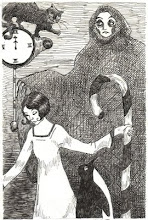
The first was something inspired by Angela Carter's Nights at the Circus (more on that later):


The next was a plague nun - something Lucy Troma related.


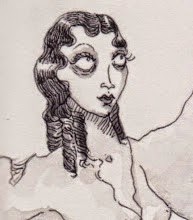
And a quick pencil and acrylic sketch of Lucy and Treena:


Wow. You can really see how rusty I was, and hadn't been drawing or making art of any kind (I mean of the picture rather than word variety)in over a decade before I did these. Well, I'm off to draw tonight to continue the process. Anyone want to come?

Tuesday, April 13, 2010

Lycanthropy: Ginger Snaps

Ginger: Okay. Search and destroy. Go.

Brigitte: Okay. Trina Sinclair.

Ginger: Excellent selection. Continue.

Brigitte: Trina Sinclair DOA in the hair dye aisle. Perished while seeking matching barrettes on nothing but diet pills and laxatives.

Ginger: Likes her shorts stuck up her ass crack.

Brigitte: Favorite homework excuse? [unintelligible. believe me. I listened to the line like ten times] ate it.

Ginger: Basic pleasure model.

Brigitte: Your standard cum-buckety date bait.

(pause)

Ginger: Good one.

- "Ginger Snaps"

It's April and I never bothered to do any end of decade lists. It all seems so arbitrary, and I feel like I don't see enough films or read enough current books to make any kind of critically viable sermon from the mount-like top ten decisions. So I'm just going to post here and there about some of my favorite films of the past decade. This post will be devoted to the excellent Canadian teen girl werewolf flick from 2000, Ginger Snaps.

Werewolves are almost universally portrayed as male, which if you think about it for five minutes is super counter-intuitive as the entire idea of werewolves is deeply entwined with the lunar cycle, and who thinks of boys when you think lunar cycle? No one. But there are all kinds of prohibitions at play in turning women into sharp-toothed, hairy, aggressive animals on film. Jezebel touched on a couple of them in a post in February. Werewolves aren't pretty, or more importantly to American movies - they aren't hot. Our culture is deeply uncomfortable with hair on girls, with directly aggressive girls (as opposed to girls who use passive aggressive machinations to get their way), and particularly with sexual aggression in girls. And no one wants to talk about periods in films, right, which would be kind of inevitable with all that lunar cycling. Ginger Snaps knows all this and uses these prohibitions to create one of the best horror movies of the past ten or fifteen years. More than almost any other film I can think of it feels like not just a horror movie about girls, but a horror movie for girls. Boys, seriously - if you are at all squeamish about period blood, this is not the movie for you.

Ginger and Brigitte Fitzgerald are sisters, less than a year apart in age and possess an almost twin-like closeness and understanding. They live in a horrible suburban subdivision where all the houses look the same and everyone lives in a series of identical, interlocking cul-de-sacs. Ginger is a few months older and more traditionally attractive than Brigitte (as two of the awful boys in their high school say: "You want to do a Fitzgerald?" "Not the little dweeb. The redhead with the rack."), although they are both genuinely weird and alienated in a way you rarely see in movies. The sisters seem to spend most of their time in their bunker-like bedroom talking about suicide pacts and how horrible everyone is except for them. For a school project (I can't begin to fathom what the actual assignment was) they create a series of photographic tableaux of violent death: murders, suicides, accidents.


Late one night, the girls are out in their neighborhood, playing a prank on one of the popular girls who is mean to them (the film is smart about this dynamic, too). Just as Ginger gets her first period, she is attacked by - something. Bear? Dog? Wolf? The girls run through the woods to escape and the thing is run over by a van driven by the local pot dealer who works in a greenhouse. As he says later: Lycanthrope. But Ginger has been scratched and bitten. She doesn't want to go to the emergency room as she's scared she'll get in trouble. Then her wounds start healing with alarming quickness. And then the changes start.

The parallels between lycanthropy and adolescence are obvious, but the way the movie explores them is brilliant. It feels both modern and mythic at the same time - an incredibly difficult achievement of tone that is shockingly difficult to hit, one I go after again and again in my own work and have touched upon briefly elsewhere in this blog. People have been telling the same fairy tales for hundreds of years because they are real. As Ginger's wolfy nature starts taking over, she both enjoys her new power and is scared absolutely shitless by it. Brigitte dashes around, trying to protect her sister both from others and herself, and to figure out what is going on with her, eventually with the help of the pot dealer who, it turns out knows a thing or two about other herbs. Aside from the blood lust and the tufts of hair and the tail (Brigitte helps Ginger tape it down before gym class), she is also suddenly both sexually available and sexually aggressive. Ginger finding her inner hotness is a cliché (in one of the films few lazy moments, she does the traditional babe walk down the hall at school in slow-mo as all the boys check her out), but her aggression is not.

Portraying any sort of sexual aggression in young women is still pretty rare. As Ginger fools around with a boy in his car, her enthusiasm causes him to say, "Just sit back and relax." She immediately snarls back at him that he should be the one sitting back and relaxing, and she pounces. Her aggression is real and it's not played for laughs. There aren't a great many female werewolves to compare Ginger to, but I don't think we can even begin to talk about sexual aggression in young girls and supernatural allegory without talking about Buffy the Vampire Slayer. I read one review a while ago that summed up Ginger Snaps by saying it played like a particularly good episode of Buffy, and they do seem to occupy the same psychic space. I think there are more sexually aggressive young women in the seven seasons of Buffy than were seen in all the rest of the history of television combined. I mean, what other show has the title character embark on an intense sexual relationship that results essentially in a months long hate fuck born of rage and suicidal self loathing during which she blames herself for being a Bad Person but when she fesses up, her friend (likely voicing the feelings of the show's writers) says, "Look, it's always more complicated then that.". Interestingly, there are still people on the internet who blame Buffy (the character, not the show) for emasculating vampires - or maybe men in general, who knows. I loved that they showed men being constantly freaked out by her strength in a kind of primal way. And don't even get me started on the murderous and damaged Faith who seduces Xander, the ultimate beta-male in season three and then nearly strangles him to death. The one time a female werewolf made it onto the show, it was a little disappointing. She was the voice of unrestrained desire, but she was also kind of evil, and was eventually punished for it.

if you start googling terms like female werewolves menstruation, the hits you get most often cite Ginger Snaps and Angela Carter (for real. I'm not just trying to shoehorn in my favorite writer). Her most often read (and her most often taught) book, The Bloody Chamber, ends with three wolf stories. In her most famous story of all, "The Company of Wolves" (later made into an intriguing, but unsuccessful film in collaboration with Neil Jordan), the girl in the red cloak laughs in the wolf's face when he says he is going to eat her up and she winds up in her dead grandmother's bed with him, sleeping between his paws. In her stories, women turn into tigers and wolves and the forests are never safe.

But more than anything else, Ginger Snaps is a story of sisters. The story belongs as much to Brigitte as it does to Ginger. She is smart and resourceful, and the protective love she feels for her sister is truly affecting. It is she that provides the forward momentum for the story as she does everything in her power to make things okay as she sees Ginger slipping away. There is a desperately sad scene late in the movie when Brigitte walks into their shared bathroom and sees her sister covered in blood and in tears as she has tried to cut off her tail. Which sounds silly in print, but it's so awfully sad in actuality. Another kinship between Ginger Snaps and Buffy is they both possess the courage to take one's story to its logical conclusion. Ginger Snaps ends tragically, as it should. There is no reset button.

Thursday, August 20, 2009

FringeNYC 13: A Time To Dance

The last sentence of my very favorite book, Angela Carter's Wise Children is: What a joy it is to dance and sing! For my money, it's the best novel about theater ever written - the story of Nora and Dora Chance, identical twins and geriatric chorines whose long life and career zooms through celebrity, decay, musical reviews, Hollywood, men, boys, and a Shakespearean theatrical dynasty. It's music hall magic realism and just dizzyingly good.

Libby Skala's A Time To Dance possesses that same rare and joyful energy. Skala plays her own great-aunt, Elizabeth Polk, in a gleeful one woman dance/performance through two world wars, fortune, poverty, innovation (in both dance and clothing fasteners), and a hilariously bad marriage. It's difficult to explain accurately the charm of this show. As played by her niece, Polk was clearly one of the world's rarities - a deeply happy person who possessed the gift of bringing joy to others. Late in her life she pioneered dance therapy, using movement and dance to enrich and help the lives of deaf, developmentally disabled and emotionally disturbed children. I do wonder whether the benefits derived by her students stemmed from the methods she developed or from her own force of personality. Polk had a long, well lived life and Libby Skala is an extraordinary performer. This is a great story, told with economy, verve and just a grain of the magical.

Interestingly, after I saw the show, I was raving about it to a male acquaintance. After I described it briefly, he asked me, "is this a girl play?". I very nearly lost it. Why do so many people who should know otherwise believe the lives of women could only be of possible interest to other women? To answer the question: No. It's for everyone.

Back to Libby Skala. A few years ago I saw her show, Lilia!, in which she played her grandmother Lilia Skala - Elizabeth Polk's sister. She had a fascinating life as well - she trained as an architect, acted with Max Reinhardt's company (which made me wonder if she knew Hedy Lamarr), and went on to receive an Oscar nomination for acting in Lilies of the Field opposite Sydney Poitier. Clearly, Skala comes from an extraordinary family. And this is the best part - there was a third sister.

Elizabeth Polk, 1930s Vienna


A Time To Dance
Theatres at 45 Bleecker Street - The Lafayette Street Theatre
Artistic New Directions
Writer: Libby Skala
Remaining Performances: Thurs 20@9:45, Fri 21@3:00, Mon 24@9:45

(photo courtesy of Grace Polk)