Showing posts with label steampunk. Show all posts

Friday, June 17, 2011

The Crest Fest Art Show

This weekend sees the opening of the Crest Hardware Art Show in Williamsburg. Sponsored by and situated in the Crest Hardware store, the show features works constructed from items commonly found in - you guessed it! - a hardware store.

The show kicks off tomorrow with the Crest Fest which will feature bands, DJs, beer and a sale of works by local artists. The proceeds will benefit the City Reliquary.

See at left this charming octopus made by Jude Ferencz. When I went and looked up the photo credit, I was happy to see the picture was taken by friend of The Cabinet, Theo Coloumbe of the Brooklyn Photo Studio. You can see more works from the exhibit here.

They are located here. In fact, it would really be beyond convenient to stop by this fest and then just run down the block and see a few offerings in The Brick's Comic Book Theater Festival (which I can't link to directly because of some egregious Flash usage, so facebook it is).

Wednesday, October 28, 2009

Steampunk in Oz and Elsewhere


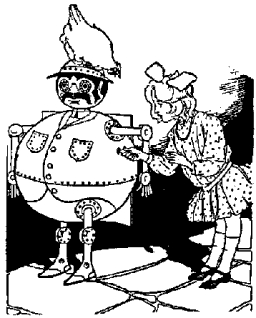
Suddenly every post is in some way inspired by Oz (which, in my defense, is so much better than that week when every post was inspired by the Holocaust). I had been thinking about my favorite Oz book (Ozma of Oz), and about Tik-Tok the clockwork man, and decided that now was a good time to finally read the Ann* and Jeff VanderMeer edited Steampunk anthology that's been sitting on my shelf for a while. Like most anthologies, it's pretty hit or miss, but happily, the hits predominate. There are three non-fiction essays included and, in my opinion, one glaring omission.

The stories that particularly impressed me were:

"The Giving Mouth" by Ian R. MacLeod. It's beautifully written and so very, very strange. I'm not sure it strictly qualifies as Steampunk according to my understanding of the term - it's set in a fictional feudal dystopia with mechanized elements, but the writing is lovely. It reminded me a bit of some long, strange meandering fairy tales I have read (again, with mechanized elements). The only quibble I have is that the world building was a little stronger than the story telling.

"Seventy-Two Letters" by Ted Chiang was simply awesome. It's set in a slightly altered Victorian England where golems are being created and given life in factories by scientists and sculptors. It's about 50 pages long, and in this short space he manages to tell an intricately plotted story, explore the moral implications from the point of view of labor, bio-ethics, eugenics, religion and gender. The fact that the story remains exciting and it never bogs down is a tiny miracle.

"Victoria" by Paul di Filippo is so daffy, light-hearted and well written I loved it in spite of my better instincts. I hate it when men write stories and all the women are whores because it's really the most boring default setting imaginable - and this is no exception. But - otherwise this story is such an engaging delight I'll pretty much forgive it anything.

Speaking of one's better instincts, Joe R. Lansdale's splatterpunk Boy's Own story, "The Steam Man of the Prairie and the Dark Rider Get Down: A Dime Novel" is completely and totally disgusting. It's full of violence, rape and assorted over the top mayhem - and I couldn't put it down. Sue me.

The Neal Stephenson and Michael Chabon entries are also totally worth reading, but that's to be expected.

Now for the glaring omission. This might have more to do with my personal interests, but I think leaving Oz out of the Steampunk equation is madness. Aside from Tik-Tok the clockwork man, L. Frank Baum's Oz books are filled with mechanical inventions. Both Professor H.M. Wogglebug, T.E. (the "H.M." is short for "highly magnified", "T.E." is short for "thoroughly educated") and the Wizard come up with lots of exciting mechanical inventions and devices. The sensibility in Baum's books is so remarkably modern, so specifically American, they really do deserve to be mentioned in the same essays as the Steam Man from the much more poorly written and rarely read boy's stories. Again, it may be my own prejudices at play, but is that the issue? That the Steam Man is from literature aimed at boys and Oz is so happily inclusive of girls? I don't think the omission was intentional, but I really do think it worth noting.

They weren't among my favorites, but several female writers were represented in the collection. I love the VanderMeers' sensibility - I also strongly recommend their completely engaging The Thackery T. Lambshead Pocket Guide To Eccentric and Discredited Diseases. They are both on the faculty at Clarion this year. I've been thinking about applying for a while but have never gotten myself together in time -I'm still a little traumatized from missing the Neil Gaiman/Kelly Link year.


* Interestingly, in the interview with Ann VanderMeer I linked to, when asked how she became interested in genre, she responded thusly:
Hard to say. I’ve always been an avid reader and lean more towards horror, fantasy and science fiction in my reading tastes. My dad had a collection of all the early L. Frank Baum books from his childhood. And I’m not just talking about The Wizard of Oz, I am talking about the entire series. These were the editions from the 1940’s and they were absolutely beautiful.
One more thing I'd like to note: how hilarious is Tik-Tok's patent infringement notice?

Sunday, October 11, 2009

So, who's up for this?

I think I have a shiny new obsession which is really the very last thing in this world that I need right now. A friend's remarkable facebook photo led me to this post on Coilhouse.

Sigh. I am completely, gobsmackingly in love. The photo at left, and the others posted are actors in costume from the original 1908 Moscow Art Theatre production of Maeterlinck's The Blue Bird.

I've been staring at these pictures for a day now, and all I can think is that we live in aesthetically barren times. Or maybe I'm just out of step with the prevailing aesthetic of my own time, which is far more likely. I wrote about this a little earlier and I am more obsessed than ever with the art (both commercial and fine) in the late 19th and early 20th centuries. Mind you, I have no desire to live in those times as I like voting and birth control and computers and antibiotics, but the art was really, really lovely.

I went to acting school in a long ago other lifetime, and this is where I first realized that I find a lot of theater to be really, really boring. I blame a lot of this on American theater artists in the 20th century foisting their very male oriented emotional melodramas upon all of us, worshiping at the shrine of Stanislavsky - but, wait. An interesting little fact: the director of this remarkable looking production of Maeterlinck's very interesting fairy tale was none other than Constantin Stanislavsky.

Although lots of people have conflated that goddamn Method with the teachings of Stanislavsky, they are really entirely different. I'll take the Russians any day, clearly. I realize I'm on shaky ground here, as my most loyal commenter Fuzzy Bastard knows infinitely more about these things than I do (two of my most constant readers have studied theater in Moscow, actually) so I'll return to what I can talk about with some kind of authority.


By which, I suppose I mean the realms of the visual and of fairy tales. I don't think many people could put together a convincing argument against the statement that the commercial and book illustration of the turn of the last century was unmatched by anything either before or since. The combined elements of new, modern printing techniques, a strong pre-Raphaelite influence, art nouveau, a fashion in elaborately illustrated gift books, and the resurgence of the literary fairy tale formed a perfect eco-system for the best illustration ever seen.

The super high end work like Arthur Rackham, Edmund Dulac and Kay Nielsen (who lived long enough to do a lot of the artwork for the Night on Bald Mountain sequence of Fantasia) is so good I can't even get my head around how it was done on an even basic technique level. But I think the ones who influenced me most deeply when I was a child reading fairy tales and learning how to draw were the lesser lights like H.J. Ford and John R. Neill. Probably because I could figure out how it was done. One of the things I've always found particularly delightful about Neill is that his work is so obviously a part of the mechanical, steam age. The artistic pairing with L. Frank Baum was perfection.

The photos of the actors dressed for Stanislavsky's production of The Blue Bird have a bit of that same machine-age feel. I've been fascinated with Maeterlinck's play since I was a child and read Noel Streatfeild's wonderful book Ballet Shoes in which Pauline and Petrova played Mytyl and Tytyl in a West End production of the play. There was a silent film version directed by Maurice Tourneur (which looks lovely) and a later sound version with Shirley Temple (which looks dreadful). It has been pretty solidly out of fashion since then.

What worries me is that looking at all this makes me want to do nothing else besides directing an elaborately staged and designed revival.

Saturday, January 24, 2009