Showing posts with label surrealists. Show all posts

Tuesday, May 31, 2011

Vogue, 1946

Hattie Carnegie dress. Erwin Blumenfeld photo. Vogue, 1946

I love how surrealism completely infiltrated fashion photography (after all, Vogue paid the bills for many an artist). I also love how even for a sort of workaday spread, Blumenfeld goes all out.

Monday, May 30, 2011

Vogue: Cover by Dali

I occasionally buy decades old issues of Vogue when I see them and have the cash. This 1944 issue, however, can't really be had for love or money (okay, maybe for love).


(image via kenodoxia.tumblr.com)

RIP Leonora Carrington

"I didn’t have time to be anyone’s muse… I was too busy rebelling against my family and learning to be an artist." - Leonora Carrington, 1983
But still, in the very first sentence of her New York Times obit, her relationship with Max Ernst is referenced. I have a feeling that might have rankled, though she admitted her debt to him, often. She was a wonderful painter who lived a long, productive and interesting life.

Like all artists (particularly of the female variety) she was remarkably self determined. Born into an upper class English family, running off to Paris to join the Surrealists wasn't precisely what her parents had in mind for her, to say the least. She ran off with the much older Ernst when she was about 20 and painted and wrote. There's a great anecdote about Jean Miro handing her some money and telling her to go get some cigarettes, which she essentially threw back in his face.

She first came to my attention because of her obsessions with the occult, alchemy and myth. She wrote as well as painted and I think I first encountered her work in an anthology of fantasy written by women. Like Ernst, she was a surrealist down to her very marrow. Her work is strange and autobiographical, oddly matter of fact in tone.

As for most everyone of her generation, the war was the defining event in her life. Ernst was imprisoned by the Nazis (but arrested first by the French Vichy government I think it's worth noting), and Leonora fled to Spain. She suffered a breakdown and her parents had her committed to a horrific asylum. I have no idea how apocryphal this is, but I read that she was rescued from the madhouse by her former Nanny, who arrived in a submarine. She eventually made her way to Mexico where she spent most of the remainder of her life. She and Ernst, both damaged by the war, never reconnected.

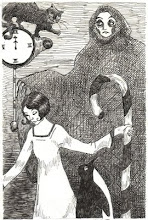
In addition to her painting and writing, she also designed for the theater. The picture above shows costumes she created for a show directed by Chilean director and filmmaker, Alejandro Jodorowsky, who she mentored. Her life was long and interesting and productive but, naturally, I suppose, most people want to hear about the short years with the Surrealists in Paris. It was a time of such outrageous creativity, one just longs to have been there. At least I do - in my time machine wish list, Paris between the wars ranks high.

Leonora Carrington died this past week at the age of 94. In an odd way, I wish she could come back, as she is a painter uniquely suited, I believe, to showing us what the afterlife looks like.

Friday, May 13, 2011

Alfred Kubin: Symbolist Artist and Proto-Surrealist

Alfred Kubin, born in 1877, was a strange, reclusive and emotionally fragile artist and illustrator. When he was about 20, he attempted suicide on his mother's grave and suffered a series of breakdowns. It was around this time that he discovered the work of Odilon Redon, Edvard Munch and Max Klinger and was profoundly influenced by them. Previously apprenticed to a successful landscape photographer, he moved into working in mostly pen and ink and lithography and began traveling in German avant-gard circles.

His work is grotesque and nightmarish, and feels profoundly Freudian (lots of scary vaginas). One the war started he pretty much became a recluse, and remained one for the rest of his life, holing up in a 12th century castle in Austria. His work was declared "degenerate" and "decadent" by the Nazis (if one wishes to be strictly truthful, he was both. The question is really whether you have a problem with it or not), but they pretty much left him alone. Unsurprisingly, he illustrated work by Poe, E.T.A. Hoffman and Dostoyevsky.


He also wrote a couple of strange dystopian novels, all of which are sadly out of print in English (unless you have a Kindle!). It's all terribly evocative. I decided to feature him here because I found that once I started looking at his pictures, I simply could not get them out of my head. I haven't read his famous novel, The Other Side, but I've heard very good things. One wonders what went on in his mind as he worked alone in his castle. One looks at his work and shudders.


Thursday, March 31, 2011

Elsa Schiaparelli: Surrealist Fashion Icon


I'm beginning to feel a lack of surrealist couturiers, so I thought I'd do a brief Elsa Schiaparelli posting. She was an artists and a dressmaker and an innovator. See above her famous shoe hat of 1937 on which she collaborated with Salvador Dali. Below is her lobster dress from the same year.


Most innovative of all, her skeleton dress.


I can't be the only person who longs for a time machine assisted Gaga/Schiaparelli collaboration, can I?

Wednesday, January 26, 2011

Dainty Cadaver!


Just a reminder, boys and girls, that I will be participating in an exciting theatrical experiment brought to you by the delightful folks at Piper McKenzie and The Brick Theater, Inc. It's a series of plays written Exquisite Corpse style. That is to say, each playwright only saw just what came before and proceeded as they saw fit, and then the next playwright in line only saw what they wrote. And so on. It's essentially a Surrealist party game.

I will be in Saturday's group ("B") which will be directed by the always fetching Miss Hope Cartelli.

Information an tickets can be found here.

Thursday, December 2, 2010

Vogue: The Kraken

I have a complex, quasi-abusive, and completely unbreakable relationship with fashion. In so many ways the entire industry is indefensible. But, like with those people who like the running and catching and throwing and such, I remain, as they say, a fan.

And, like it or not, in the center of the melee, like a bloated, multi-tentacled Kraken, sits Vogue. Its current American edition is ridiculous, as gorgeously documented by former West Egg resident R.J. Cutler in his documentary, The September Issue. The film took a look at the nearly 40 year (!) working relationship of Editor in Chief Anna Wintour and Creative Director Grace Coddington (they started off at British Vogue in the 60s, then both made the move to New York). The various editions of Vogue are often out of touch and embarrassing. The American version is dull and stagnant and honestly, I couldn't care less about the current version of this particular beast. But in its first few glorious decades, it employed such luminaries as Man Ray, Edward Stiechen, George Hoyningen-Huene, Horst, Cecil Beaton, and Lee Miller (who scooped the NY Times with her coverage of the liberation Buchenwald as she traveled with Patton's army. Miller is a personal hero of mine and deserves her own post.). In the teens and 20s the covers featured gorgeous, modern illustrations.

But, every once in a great while, most often in their Italian or Paris editions, Vogue will come up with something that produces at least a dim echo of their former glory. Such is the case in this month's British edition which contains an achingly lovely editorial spread based around a zodiac theme. The photographer is Tim Gutt. The sets were designed by Shona Heath. And the model is Siri Tollerød. You can see the whole thing here.

Sunday, March 28, 2010

Snip

I've been looking at lots of art again, and coincidentally the two most recent shows I've seen have been all about paper and its various uses and manipulations. I made my first visit to the Museum of Design at their new Columbus Circle location to see Slash: Paper Under the Knife, and I'm so glad I did as it pretty much blew my head wide open. Two full floors of extraordinary works mostly made with paper and knife (or laser). Many of you might recognize the work of Béatrice Coron as she has had lots of artwork displayed in the subways. But the small posters on the F Train are nothing compared to her floor to ceiling black cut-out versions of heaven and hell (Hint: heaven and hell really don't look that different). She has endless tiny figures cut out of tyvek in a humorous, Boschian, ant farm like cross section.

My favorite by about a mile, though, were the series of about two dozen tunnel books by Romanian/American artist Andrea Dezsö. They are meticulous and beautiful little boxes, painted in jewel like colors. At bottom, much as I am moved by aesthetics, it will always be the marriage of aesthetics with narrative that leaves me breathless. She paints monsters, aliens, insects, little girls lost in the woods; cityscapes and forests. Every once in a great while I'll come across an artist who has seemingly reached into my skull and pulled out imagery or stories that seem to have been there already, unrealized and waiting and it never fails to bring me to my knees.

The evening before I saw Playing With Pictures: The Art of the Victorian Photocollage at the Met. I can honestly say that it's not really like anything else I've seen and I've seen a lot. It's three rooms full of pages of photo albums which have been meticulously (and beautifully) painted with photos cut out and collaged into surreal, creative and sometimes disturbing designs. The heads of women pasted onto the bodies of ducks. Acrobats, harlequins and spiderwebs with photos of family members and pets inserted into the designs. All the works shown were from the mid to late 19th century - in other words surrealism before most of the surrealists were born. Lewis Carroll meets Terry Gilliam.

All of these skillful and odd works were created by women, none were professional artists, and certainly with very little thought of public exhibition. They were created at home, from photographs of their husbands and children and dogs and parents. It was a time when women like these weren't called "talented", but "accomplished". Women of their class were expected to paint and play piano and sing and pour tea. They had accomplishments, they entertained in the evenings, they stayed at home. Aside from the obvious skill and charm of the images on display, something I found particularly thrilling were the madcap levels of whimsy and imagination demonstrated. It made me wonder what these women were like. They possess that strange Victorian surrealist morbidity that Edward Gorey capitalized on so interestingly for all those years.

Of course, the Metropolitan Museum is a magical place at all times, and I realized I haven't been going back as much as I should. They have music and wine on Friday nights still, and soon the roof garden will be open and sometimes you can see the falcons that live on the Upper East Side that occasionally swoop over the park. Of course, one could construe all of this as being unspeakably romantic, which just might lead one to walking for blocks down 5th Avenue on a warm spring evening, which would inevitably lead to kissing on a park bench until it got too cold and too late and everyone had to take the subway home. I mean, it might.

Tuesday, October 13, 2009

Who doesn't like a good desecration?

I know, I know I spent yesterday's blog post raving about how much I like the fin de siecle commercial art from the last century. And I do. But I also have a real fondness for the punk rock desecration of dada and the burgeoning surrealists after the First World War. A couple of weekends ago I went to the Art Book Fair at PS 1. I didn't bring much cash or my checkbook as I didn't want to spend more than I could afford. The one thing I did buy was an unbound sheet from Max Ernst's surrealist novel, Une Semaine du Bonté.


I'm really pleased with it, but I'm not sure what to do with it. It's two sided, so it's complicated to frame or mount. The thing managed to survive a world war pretty much unscathed and there's a part of me that thinks it might be appropriate to shoot bullets through it. I've been thinking about this since going to see the Emory Douglas exhibit at the New Museum. It's really extraordinary stuff and so worth seeing, but I've always thought there's something a little weird about looking at revolutionary art in clean museum spaces devoid of the context in which it was originally created.


The theater we made in the '90s on the Lower East Side felt revolutionary, and out of that sprung the New York International Fringe Festival, which has become a cultural institution itself, for good or ill. A lot of theater artists I respect feel that we are in post-narrative times and the only argument have against this is that I really, really like narrative, which isn't an argument at all. Humans crave structure and this craving comes from a deep, primitive, DNA level of need. (one of the things I've read that really helped me make sense of the world is, "Humans like categories, nature likes a spectrum"). And if there's one thing I've said again and again it's that structure in a theater piece does not equal plot.


I haven't completed a play in a really long time. I'm a very bad playwright. I began working on a play called Tricks With Makeup shortly after 9/11 which has been gnawing at my brain ever since. I never thought of it as being surrealistic, but that's what it is. Then a year or two ago I began working on it again as a short story. I think I just need to finish it and not worry about it making sense. I've also been (finally) working on a new play called The City is an Island, which like Tricks With Makeup takes place in a bar. I keep on thinking of City as my Brecht play, silly as that may be in light of the NYC Kill Your Idols aesthetic I was raised with. It's an apocalypse play with songs.


A lot of theater is really boring, and I think the proliferation of MFA programs has caused this country to be inundated with even more boring, bad theater. It's frightening to me that people writing boring bad plays in MFA programs are compounding the problem by teaching innocent little undergraduates. Today someone on Facebook posted this interesting article about Lesbian theater artists, which included the following quote from Sarah Schulman:
"The most destructive ethic in mainstream theater is that familiarity equals quality. They think that work that repeats what is already known is good, and work that expands what is already known is wrong or badly written."
Happily, Schulman is teaching now, and Paula Vogel (the playwright who made me want to be a playwright) is heading up the program at Yale and I've heard that Scrappy Jack is teaching, too. Baby steps, I guess, but I truly believe that good art is not born out of the University system, and if good art does emerge from MFA programs it is a completely inadvertent and random occurrence, and not any sort of proof that this is an effective way to train artists. My displeasure with how theater is taught in schools really deserves it's own post, so I won't go into it too deeply here. Let me just say that theater is multi-disciplinary by nature and that fact is pretty widely ignored. Also, good artists tend to figure things out for themselves in or out of school. So, I guess what I'm saying here is that I'm ready to throw myself back into the fray. A lot of years have passed, and one of the people I used to talk about this stuff with is working for Big Law, others don't speak to me any more, and I've become reacquainted with other artists that I used to know. I'm pretty sure I want to spend my middle years making things, so I really need to start now.

Wednesday, July 16, 2008

Surrealists Are So Pretty But Then So Many Artists Are Forgotten


A couple of weekends ago I watched a Netflix triple feature: The Triumph of Love, Romper Stomper, and Once. It was lots of fun as none of these films had anything to do with each other and I'm the kind of person who only listens to her ipod on shuffle.

Romper Stomper is really disturbing and really well done, but judging by a quick google search it has been embraced by every stripe of wannabe violent asshole, which is a pity. It's a show boaty, high energy Clockwork Orange-influenced tragedy about Australian Nazi skinheads. It was Russell Crowe's second major film role and he is really, really good in it. His performance as this really menacing, tightly wound skinhead is so completely different from the likable character he was in Proof (directed by Jocelyn Morehouse, PJ Hogan's wife), a movie I really adore. Once, as basically every other person on the internet has already said, is a complete joy. Triumph of Love was sort of a mess, a filmed version of a Marivaux play, starring a sort of incompetent Mira Sorvino. It had a lot of ideas, such as seeing flashes here and there of a modern day audience sitting on folding chairs watching the action. It was directed by Tasmanian Clare Peploe, who got her start as the writer of Anonioni's hippie epic, Zabriskie Point. Which brings me back to The List I started a couple of posts ago.

Lois Weber is someone I had never heard of until I began researching female directors for this blog project. According to IMDb, she directed 132 films (although according to Film Reference the number could be well over 300) and was the first woman to direct a feature. There is a clip from her film Hypocrites on YouTube and it really makes me want to watch the whole thing. It's beautifully shot, and I'm not entirely sure what is going on but it features a priest and a naked ghost girl and it's super ethereal and lovely (Note: the music used, however, is super annoying. I suggest you mute it). Lois Weber was a rabidly successful silent actor, director & producer. She was the highest paid director at Warner Bros. and from what I can gather (up to 90% of all silents are lost, few of her films survive), she explored moral hypocrisy and society's ills from a kind of early 20th century religious/progressive/feminist perspective. Her films looked at abortion, birth control, capital punishment and drug addiction and made lots and lots of money. Like many successes of the silent era, the combination of a messy personal life and the coming of sound killed her career. She found some work as a script doctor and then died penniless in 1939. She has a star on the Hollywood Walk of Fame (6518 Hollywood Blvd.), and is all but completely forgotten.

Maya Deren. Why are all the lady surrealists all so, so lovely? Maya Deren was an experimental film-maker who although she rejected being classified as a surrealist, made a number of films which share many qualities with the films of Cocteau, Buñuel and Duchamp (who she at one time collaborated with). Her most famous film Meshes of the Afternoon, is like a dream. I do not mean what is usually meant when people describe things as being "dream-like". It is just like a dream, in its constant repetition of events with slight variations, confusion of identity, its use of the subconscious and of ritual. It was playing on a loop at the Tate Modern when I was there, and I just sat and watched it two or three times in a row. I love At Land, which somehow manages to build an unimaginable tension through its imagery and silence. In 1947 she received a fellowship from the Guggenheim Foundation to travel to Haiti and study Voodoo. She died young in 1961 from a brain hemorrhage brought on by malnutrition and amphetamine addiction. Or possibly from a voodoo curse. One never knows.