Showing posts with label clowns. Show all posts

Tuesday, December 21, 2010

Clowns and More Clowns

I hope I never get so jaded I start taking for granted the city I love, the city in which I live, the city of my birth, the city of my dreams. By which I mean, of course, Gotham. New York City. It's all finite space and building up and over. Forward looking, with an endlessly fascinating history that hardly anyone seems to know much about. Like the other great cities of the world: London, Paris, Tokyo - you can never come to the end of it. There's always more, always something you didn't know about, something old or new that you've never seen or done. It never stops being thrilling. It's like the internet, but in real life!

So, pretty much everyone knows there are clubs in our fair and violent city where jazz musicians experiment and play for mostly other jazz musicians, workshops where theater people show work that's still in process to other theater people. Rooms and coffee shops and bars where poets read their new poems for others of their bearded and bespectacled ilk, and open mikes where comedians mostly make each other laugh (or attempt to). But what of the clowns? Where do the red of nose and floppy of feet go to juggle and fall down and work out their complex physical business before presenting their artistry in Tops, both big and small? They go to The New York Downtown Clown Revue, that's where - as did I last night, escorted by silky downtown impresario, Trav S.D.

Founded, hosted and curated by Christopher Lueck (old friend and onetime collaborator - he played the White Bear in the FringeNYC version of Antarctica), he had seemingly retired the Revue last year, but it has happily re-emerged at Dixon Place, a venue close to my heart as they were the very first people to pay me actual money for being a playwright. The snazzy new seats were close to filled with off duty clowns who had come to see what their brethren were up to. Like any night of variety, it was a mixed bag. Clowns are curious folk, and at certain points during the program it felt a bit like being locked in the Monkey House after hours, when one is not a Monkey oneself. Chris is a delightful and enthusiastic host who has divided the program between Presented Acts and Commissioned Acts. Matt Mitler, one of the commissioned performers (his brief was to come up with a short, shamanistic clown piece with musical meditation themes) achieved something completely and distinctively strange, which he performed with absolute commitment and was really not much like anything I've seen (and, as I've said many times before, I've seen a great deal).

But the highlight of the performances was easily the masterful Joel Jeske (who also performs an act, The Hey-Ya Brothers, with Mr. Lueck), joined by surprise guest, Grandma (AKA Barry Lubin), of Big Apple Circus fame. They were simply hilarious. I fear sometimes, that with all the European training some clowns acquire, and all the theory, modern clowns sometimes forget to be funny. Mr. Jeske, in pitch perfect straight man mode, attempts to sing Christmas songs and play his ukulele. Grandma, the most disruptive audience member imaginable, prevents this from happening. Hilarious. Then Grandma brought an audience member onstage and they squirted water at each other. Hilarious. Comedy is unexplainable. It's all precision and practice and practice and more practice. Like being a ballet dancer. But funnier. And they fall down more.

The New York Downtown Clown Revue is the third Monday of every month. For more information, go here. For my darling inamorato's review of the revue, look here.

Thursday, September 9, 2010

The Man Who Laughs

When I really stop to think about it, I may divide all movies and theater into one of two categories: Boring and Not Boring. Sadly, to modern audiences, many silent melodramas fall squarely in the realm of the Boring. Not so with The Man Who Laughs! The whole thing is just a non-stop delight. If you've been looking for a horror-melodrama with a swashbuckling clown: this is pretty much your only option.

The film is based on the rarely read Victor Hugo novel of the same name. In it, Gwynplaine, a small boy is sold to child mutilating gypsies called The Comprachicos by agents of King James II because of his noble father's disloyalty to the crown. Little Gwynplain's face is carved into a gruesome and permanent smile, while his father is tortured to death in an iron maiden. Gwynplaine is abandoned by the Comprachicos when they are forced to leave England and don't want any mutilated children with them, as the mutilation of children is usually frowned upon. So, the poor child wanders a frozen, barren landscape with a scarf covering his grotesque smile. This scene is completely extraordinary. It's German Expressionism at it's creepy best, wearing it's surrealistic influences on its sleeve. Gwynplaine walks through a field of gibbets hung with half rotted corpses.

He sees a young woman frozen to death on the road, but the baby in her arms is still alive and Gwynplaine saves her life by taking her along with him. He soon comes to the cabin of a hermit/mountebank/philosopher who kindly takes the children into his home, which he shares with his (really, really unfortunately named) wolf, Homo. The part of the wolf is played by an exceptionally sweet faced German Shepard named Zimbo. The baby turns out to be blind.


A couple of decades past and Gwynplaine and his ad hoc family make a living by performing a clown show/freak show in carnivals where he is billed as "The Man Who Laughs". The blind infant has grown up into a beautiful, sweet young woman. The carnival scenes are just the best. They are filled with life and movement, and the kind of hysterical enjoyment achieved only by people whose lives are unremittingly dark, hard working and grim. The extras are just incredible. They are present and lively and it appears they were cast via time machine. Wanted: Hordes of Syphilitic Rabble! There is some fun contrast between the chaotic fun of the fair grounds, and what passes for entertainment in the court of Queen Anne, who sits toad-like and frowning on her throne (the actress looks just like John Tenniel's Queen of Hearts). A decadent duchess becomes entranced with Gwynplaine, and we subsequently find out she is living on his father's estate and if Gwynplaine is reinstated as a peer of the realm she will lose all unless she marries the grotesque carnival player.


Court intrigue proceeds, more roiling crowds of rabble, some swashes are buckled, Homo saves the day and the lovers are eventually reunited. It's exciting and well acted in a hammy way, the girl is pretty, everyone else is a glorious grotesque, so the film has a great deal to offer. But, the design is the thing that is just mind blowing. Every frame is so rich and well thought out and manages to be both slightly off and expressionistic, but still brimming with interest and life. And a clown swashbuckles.

It's kind of amazing to me that a novel by Victor Hugo that essentially nobody's read has wielded so much cultural influence over the past 75 years or so. Of course, lots of this influence is cast by the wonderful film adaptation. A silent from 1928. That few living people have seen, considering the numbers who have seen and enjoyed its progeny.

The clearest and most acknowledged child is of course Batman's arch-enemy, The Joker (I mean, hello. Look at the poster at left). Bob Kane freely admits that he more or less stole the imagery from Conrad Viedt's distorted face. The similarities are emphasized in 2008's Dark Knight where Heath Ledger's joker speaks of his father cutting a permanent smile into his face. The largest difference, of course is that Hugo's hero is an admirable character, someone to be pitied, and The Joker is a psychopath. J.D. Salinger's Laughing Man owes more than a little to The Man Who Laughs, too. But I first came to the story through James Ellroy's novel The Black Dahlia, based on the notorious unsolved murder of b-girl, Elizabeth Short. Imagery from Hugo's novel plays a major part in the operatically over the top ending.

It's just such a strange anomalous work. The story is so strange, yet clearly so resonant, it has turned into fairy tale or myth.

Tuesday, September 7, 2010

Dame Agatha's Harlequinade

One of the projects I mean to complete before I die is my book titled "Everything I Ever Learned, I Learned From Reading Mystery Novels". Because, mostly, I did.

As I mentioned earlier today, Agatha Christie liked her literary allusions, and when I was first reading her oeuvre, a dropped reference from her would send me scurrying to another section of the library. She loved mythology and Shakespeare and music. But she had a particular fascination with Commedia dell'Arte. It comes up again and again in her books, the apotheosis being the short story collection The Mysterious Mr Quin. The stories all feature Mr. Satterthwaite, an elderly, comfort loving dilettante. He wants nothing more than to stay in nice houses and hotels, eat good food, collect interesting people, and look at art. In each chapter, Mr. Satterthwaite encounters a mystery of some sort, and a shadowy man called Harley Quin appears and helps him solve the problem by assisting him in looking at whatever the situation is, from a different direction. There are many intimations of the supernatural in the character of Mr. Quin, but little is ever explained. In some of the stories, Mr. Satterthwaite doesn't exactly meet or speak with Mr. Quin, but his presence is felt.

The book is an odd departure for Dame Agatha, but an awfully interesting one. The stories tend to be a little darker in tone, they're full of love turned to madness and jealousy. People's identities are mutable in nearly all the stories. nearly everyone is wearing some sort of mask, not just the eponymous Mr. Quin. There's also an arc throughout the book in which we see Mr. Satterthwaite being shaken from his complacency, and instead of watching events transpire in front of him as if he was an audience member, he becomes an active participant in his life.

I had never heard of Commedia pre-Dame Agatha. But looking at the publication date of my copy of The Mysterious Mr Quin, I was only 12 or 13 when I first read it. Acting school, my brief time as Columbine and my happy associations with various red noses was still years away.

Note: this post is a participant in the Agatha Christie Blog Tour commemorating her 120th birthday.

Wednesday, July 28, 2010

Clown Dystopia

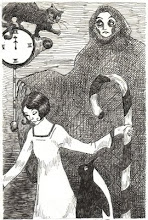
This is the old notebook holy grail image as far as I am concerned. A clown dystopia where all the fish have disappeared. It had to do with some long abandoned project that I can't even remember. Click on it to enlarge so you can read the captions.

Monday, July 26, 2010

Nights at the Circus & Wise Children: Angela Carter's Last, Great Novels


Maybe I should elaborate.

Angela Carter's final two novels before her early death from lung cancer in 1992 are also, for my (pretend) money, the two greatest show biz novels ever written. I started reading Nights at the Circus on the subway ride from my parents house to Windsor Terrace on the very first day of my taking up residency in Brooklyn. For some reason, this feels deeply symbolic to me in ways that feel profound, but difficult to articulate. Why is it that one's life tends to change in so many ways at once? I spent a great deal of time my first winter in the wilds of Brooklyn wondering what I was doing there and I read an awful lot, but it started with this one book.

Nights at the Circus is written in three parts (or acts, or rings if you like). So many novels about theater, or show business wind up being a little like the novel equivalent of one of those HBO bio pics. Don't misunderstand me, I love HBO bio pics - but I mean they tend to be I guess really linear and about the subject matter in a way that really great literature rarely is. Nights at the Circus is a truly great book that most people I know have never read. Which just kills me.

It begins at the cusp of the 20th century in London. Jack, an American reporter sits in Sophie Fevver's dressing room as she tells him her extraordinary life story. Fevvers is the toast of Europe, the greatest aerialist alive - billed as "The Cockney Venus" she has two wings on her back, and may be part swan, part clockwork or a complete hoax. Her tag line is , "Is she fact or is she fiction?" and it's really the question of the book. In all Angela Carter's books and stories, people are always changeable, nothing is carved in stone. Women turn into tigers, men wake up women, you name it. But in her last two great novels, this mutability, her obsession with facades and performance is self-consciously theatrical. She achieves the tone in Circus of a gritty, music hall, magic realism, burlesque that is quite literally completely unlike anything else I've ever read. Little Fevvers was found as an infant on the doorstep of a London brothel just beginning to sprout little tufts of down on her shoulder blades ("Looks like the little thing is going to sprout fevvers!"), was raised there, eventually finding herself in a freak brothel run by an evil, tiny dried up puppet of a woman (who may actually be a puppet). The old whore who raised Fevvers may be an anarchist (the kind that blows things up), and the reporter wonders if Fevvers is actually a man, and if anything he is told is true.

The second act is set in St Petersburg as Fevvers has been engaged by Colonel Kearney's Circus for their Grand Imperial Tour of the Russias and Japan (to be followed by their Great Democratic Tour of the United States). Jack has signed on as a clown, and there is lots of truly disquieting drunken clown mayhem and strange self loathing monologues by the monstrous Buffo the Great who turns the American into "The Human Chicken". There is the ape act, with the drunken Professor who beats his poor, long suffering mistress (who used to work for a crooked spiritualist, playing dead children), the Abyssinian Princess (ahem.) who tames tigers, a high wire act that loathes Fevvers (understandably), a love sick strongman named Samson. And Colonel Kearney himself, the ringmaster and circus owner, a huckster from Kentucky with a remarkable pig named Sybil. The story telling is strange, meandering, and baroque. The third act is set in Siberia, and here it takes a turn into the truly bizarre and nearly mystical. Circus impresarios, murderesses, would-be rapists, amnesia, winged women, tigers caught in mirrors, a Russian Grand Duke, explosions, freaks, whores, truly educated apes. Lots of it is funny, some extremely unsettling. The whole thing is just gorgeous. Angela Carter books aren't about plots, hers are usually absurd burlesques, mad enough to demonstrate that plot should never be the point of good literature.

Wise Children is my favorite novel. In the world. That I've ever read. Ever. Which actually makes it a little hard for me to speak about it rationally, as I'm determined not to resort to the listicle. It's the story of a (mostly) English show business dynasty as told by elderly former chorine Dora Chance (the rest of the family possess the surname Hazard, of course!). In the true Shakespearean tradition the book is full of twins (I think there are FIVE sets), it's besotted with Shakespeare from top to bottom (intended). Dora and Nora Chance are (probably) the illegitimate twin daughters of the great stage star and Shakespearean, Melchior Hazard. As Dora says at one point, being illegitimate, she and her twin go on the halls. And that's really the meat of the book. It's about art and entertainment high and low and everything between. And about family. About parents and children and people who are parents in name only and about the people who raise and love them. The cast is enormous, and nearly everyone in the book is "family" in some way or another to the two Chance sisters, either by marriage, blood, adoption or coercion. Their father, Melchior, never acknowledges them officially - his American brother, Perry, steps up, puts his name on the birth certificate and becomes their adored and adoring uncle.

I mean it when I say nearly every sort of enterprise that might hire an actor makes an appearance: Shakespeare (of course), music hall, vaudeville, burlesque, English pantomime, Hollywood movies, game shows, commercials, children's television, cooking shows, and on and on. The Chance sisters are raised in a theatrical boarding house by their beloved Grandma Chance (vegetarian, pacifist, nudist and drinker of créme de menthe). The appearances by real life luminaries are blessedly few and far between. Famous people are mentioned occasionally, but they remain off stage. There's a lovely description of a Fred and Adele Astaire routine - the girls' first show, and the first time they see their father in the flesh. There is also a whole Dan Leno routine in a seaside theater in Brighton, and he becomes an actual character in the book, playing Bottom in a disastrous movie version of A Midsummer Night's Dream. I had no idea that Dan Leno was a real person until I read my always charming inamorato's book on vaudeville. I may have even said out loud, "Oh! He's real!" to an entire subway car.

One of the most wonderful things about the book is Dora's voice. She's a smart, working class dame who learned how to write from her former boyfriend, just referred to by his nickname, Irish. He's clearly drawn from a mixture of Fitzgerald and Faulkner in their Hollywood years. She's by turns hard boiled and sentimental, and the set pieces are wondrous: the winter orgy outside of a burning mansion, the set of the aforementioned film of Dream, the entire Brighton sequence. The last line of the book, after a raucous party filled with centenarians, butterflies and incest, is "what a joy it is to dance and sing".

Wise Children is cast pretty much entirely with people who until fairly recently wouldn't have been allowed to be buried in cemeteries along side so-called decent people. Self-invented actors and performers and impresarios. That is to say, my kind of people.

Note: There will likely be further posts later. My Angela Carter claims don't rest just on these two novels. There is also the criticism, the translations, many other novels, the radio plays, and the truly glorious short stories and fairy tales.