Showing posts with label salinger. Show all posts

Thursday, September 9, 2010

The Man Who Laughs

When I really stop to think about it, I may divide all movies and theater into one of two categories: Boring and Not Boring. Sadly, to modern audiences, many silent melodramas fall squarely in the realm of the Boring. Not so with The Man Who Laughs! The whole thing is just a non-stop delight. If you've been looking for a horror-melodrama with a swashbuckling clown: this is pretty much your only option.

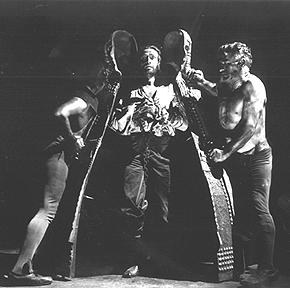
The film is based on the rarely read Victor Hugo novel of the same name. In it, Gwynplaine, a small boy is sold to child mutilating gypsies called The Comprachicos by agents of King James II because of his noble father's disloyalty to the crown. Little Gwynplain's face is carved into a gruesome and permanent smile, while his father is tortured to death in an iron maiden. Gwynplaine is abandoned by the Comprachicos when they are forced to leave England and don't want any mutilated children with them, as the mutilation of children is usually frowned upon. So, the poor child wanders a frozen, barren landscape with a scarf covering his grotesque smile. This scene is completely extraordinary. It's German Expressionism at it's creepy best, wearing it's surrealistic influences on its sleeve. Gwynplaine walks through a field of gibbets hung with half rotted corpses.

He sees a young woman frozen to death on the road, but the baby in her arms is still alive and Gwynplaine saves her life by taking her along with him. He soon comes to the cabin of a hermit/mountebank/philosopher who kindly takes the children into his home, which he shares with his (really, really unfortunately named) wolf, Homo. The part of the wolf is played by an exceptionally sweet faced German Shepard named Zimbo. The baby turns out to be blind.


A couple of decades past and Gwynplaine and his ad hoc family make a living by performing a clown show/freak show in carnivals where he is billed as "The Man Who Laughs". The blind infant has grown up into a beautiful, sweet young woman. The carnival scenes are just the best. They are filled with life and movement, and the kind of hysterical enjoyment achieved only by people whose lives are unremittingly dark, hard working and grim. The extras are just incredible. They are present and lively and it appears they were cast via time machine. Wanted: Hordes of Syphilitic Rabble! There is some fun contrast between the chaotic fun of the fair grounds, and what passes for entertainment in the court of Queen Anne, who sits toad-like and frowning on her throne (the actress looks just like John Tenniel's Queen of Hearts). A decadent duchess becomes entranced with Gwynplaine, and we subsequently find out she is living on his father's estate and if Gwynplaine is reinstated as a peer of the realm she will lose all unless she marries the grotesque carnival player.


Court intrigue proceeds, more roiling crowds of rabble, some swashes are buckled, Homo saves the day and the lovers are eventually reunited. It's exciting and well acted in a hammy way, the girl is pretty, everyone else is a glorious grotesque, so the film has a great deal to offer. But, the design is the thing that is just mind blowing. Every frame is so rich and well thought out and manages to be both slightly off and expressionistic, but still brimming with interest and life. And a clown swashbuckles.

It's kind of amazing to me that a novel by Victor Hugo that essentially nobody's read has wielded so much cultural influence over the past 75 years or so. Of course, lots of this influence is cast by the wonderful film adaptation. A silent from 1928. That few living people have seen, considering the numbers who have seen and enjoyed its progeny.

The clearest and most acknowledged child is of course Batman's arch-enemy, The Joker (I mean, hello. Look at the poster at left). Bob Kane freely admits that he more or less stole the imagery from Conrad Viedt's distorted face. The similarities are emphasized in 2008's Dark Knight where Heath Ledger's joker speaks of his father cutting a permanent smile into his face. The largest difference, of course is that Hugo's hero is an admirable character, someone to be pitied, and The Joker is a psychopath. J.D. Salinger's Laughing Man owes more than a little to The Man Who Laughs, too. But I first came to the story through James Ellroy's novel The Black Dahlia, based on the notorious unsolved murder of b-girl, Elizabeth Short. Imagery from Hugo's novel plays a major part in the operatically over the top ending.

It's just such a strange anomalous work. The story is so strange, yet clearly so resonant, it has turned into fairy tale or myth.

Wednesday, April 28, 2010

The Royal Tenebaums; or How Can Gwyneth Paltrow Be So Unaware of Our Complicated Relationship?

The Royal Tenenbaums was my favorite film of 2001, and may have been my very favorite of the whole decade. It's one of those films I love so completely and so indiscriminately, I've been having a lot of trouble writing about it. I feel a bit as if I'm just going wind up quoting my J.D. Salinger blog post, as lots of what I had to say about the Tenenbaums also applies to the Glass family (who inspired them). So I think I'll just make a list of thoughts as coming up with anything coherent is clearly an impossibility.

1. The film inhabits a New York City that seems both fictional and achingly recognizable. I think it takes place in the pretend NYC that shows up frequently in my dreams.

2. The characters are based more on people out of books than real people and therefore feel more realistic to me because I've spent more time with books than with actual people.

3. Margot Tenenbaum is a reclusive playwright with few life skills, is extremely secretive and is sad much of the time. Recently, I've been sort of unprecedentedly happy, but for most of my life this would have been a fairly good description of me.

4. That Fendi mink is gorgeous. I don't care how wrong or bad - I totally want it. Sue me.

5. The soundtrack is perfect.

6. The Tenenbaum children have all kinds of weird talents and obsessions and were strangely brilliant when children, but have a great deal of trouble negotiating the world as adults. Traits that (intentionally) mirror Salinger's Glass family and also I think to an extent, my own.

7. I love that everyone has a uniform that they wear throughout the film.

8. The house on 144th street that Wes Anderson chose to play the Tenenbaum house is just a few blocks away from the gigantic, sprawling apartment my mother grew up in on Riverside Drive.

9. I have a weirdly conflicted relationship with Gwyneth Paltrow. I think she has the slight misfortune of being a beautiful character actress. She's great in this movie and also really terrific in Running With Scissors. On the other hand, in real life, she's clearly insufferable. I know a couple of people who knew her when she was at Spence and they just hated her (to be fair, I also know one girl who liked her very much). And the whole Goop thing is an unbelievable embarrassment. And don't even start me on the Batali show.

10. Gene Hackman is the greatest American actor of the past 40 years. He's great here.

11. The paintings in Owen Wilson's apartment.

12. I know everyone hates narration. I love it. And I love nothing more than finding out what happens to everyone after the story ends the way Dickens sometimes used to tell us. They do that here and it's lovely, and Alec Baldwin is perfect because he doesn't add any annoying false sentiment as often happens.

13. The zebra wallpaper in Margot's room.

14. Several years ago my mother wrote a letter to Wes Anderson via the New York Times. He replied with a letter hand written on hotel stationary.

15. The whole Chas story is just so lovely. It's the only film in which I've been able to stand Ben Stiller.

16. The movie is completely contrived in every way possible except that it feels emotionally honest.

17. The scenes with Royal having unsafe adventures with Uzi and Ari are so hilarious and fun (set to "Me and Julio Down By the Schoolyard")

18. An old boyfriend of mine worked on some of the graphics.

19. The reveal of Margot's secret life is just priceless.

20. Dalmatian mice.

This is the second entry in my favorite films of the Aughts series.

Thursday, February 11, 2010

See More Glass

People I've never met die all the time. And people I've never met, but have admired and in some cases almost loved, have been disappearing pretty regularly. But I've never cried before when one of these strangers died until a couple of weeks ago when J.D. Salinger died behind his fortress of implacable silence.

It's taken me a week or two to get my thoughts in order which is why I will never be a journalist, but I'm glad I waited. I'm still not sure why this stranger's death felt so meaningful to me. I've never harbored any dreams about making a pilgrimage to New Hampshire and being "the one" he would spill his guts to after all these years. I mean, how awful would that be? I prefer to keep my illusions intact.

The Catcher in the Rye has never been that big a deal to me, though I hesitate to say exactly what I feel about it as I haven't read it in well over 20 years. And I've never wanted to meet Salinger. So all this feeling is tied up in the 300 or so pages that comprise Nine Stories, Franny and Zooey and Raise High the Roof Beam, Carpenters (in honor of my completion mania, I'll throw in Seymour, an Introduction, too. I love the part where he's describing his middle class Manhattanite mother-in-law as being incredibly heroic).

When I read Nine Stories in high school I thought I had found God. After Franny and Zooey, I knew I had. After Salinger's death I reread the stories which I don't think I've done in about a decade. I still loved them and I was pleased to discover that I remembered them very accurately. My enormous love for the Glass family was intact and undiluted. For those who haven't read the stories, here's a rundown of the basics: Vaudevillian parents, Irish/Jewish Manhattan upbringing, seven kids - all of whom appeared on the radio quiz show, "It's a Wise Child". Seymour, the oldest, committed suicide. Buddy, the second son, is clearly Salinger's alter ego. Franny and Zooey are the two youngest, both actors. For a while I used the piece where Franny goes off about how awful actors are as my audition monologue. When I worked on it in class, my teacher said, "Your acting problems aren't acting problems. Go see a shrink." Probably rightly so. Salinger was also (along with Maugham's The Razor's Edge) my first introduction to Eastern philosophy* which opened up some new avenues of thought for me.

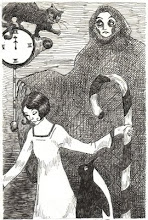
"The Laughing Man" though one of the Glass-less stories may be my favorite. I think I've been hopelessly influenced by it, as upon rereading it, I saw bits and pieces of this 15 page story in nearly everything I've written. The whole idea of the Paris-Chinese boarder may be one of my favorite things in any story anywhere, and have loved imaginary real places ever since.

I read these stories and fell in love with them long before I was capable of analyzing why I liked anything, but certain things seemed really clear. His writing is pitched emotionally in a place in which I am very, very comfortable. I've said the same thing about Wes Anderson's movie "The Royal Tanenbaums" which was my favorite of the past decade and was heavily influenced by Salinger's stories. I guess what I'm saying is that I don't find any of the emotional content embarrassing. The people in these stories feel recognizable to me in ways that fictional people rarely do.

There is also a solid New York City vibe in the stories - to the extent that upon rereading I realized that I didn't just feel as if I knew these people, I actually knew them. The Jews and Irish of upscale New York and environs were all I knew growing up in West Egg. And Salinger's mid-twentieth century Manhattan was the city of my parents and my uncles who worked in television and my grandparents who lived on the Upper West Side until they retired and flew south. The Glass children were alienated from the same world I was alienated from.

So to get back to why this death seemed like such a big deal to me - I'm still not sure. My life has been full of endings recently. Virgodog and I are splitsville. A dear family friend passed away. My best friend and collaborator parted ways from me about a year ago. So maybe I was just wide open and ready to be moved by the death of a stranger. Or maybe I'm just waiting like everyone else to see if there are any new stories. I half-believe he left instructions to have everything burned upon his death like Kafka and Emily Brontë did. I'm torn. Joyce Maynard said there was at least another entire novel. But maybe it's best if we're just happy about what we have and not always want more and all of us should stop thinking about more Glass family stories and that lost novel of Emily's that Charlotte consigned to the flames. Strangers are still strangers no matter how many of their books we read.

*Okay - maybe Kerouac, too, but I could never stand him. I've gotten into more arguments with more people defending my loathing of Kerouac than almost anything else.