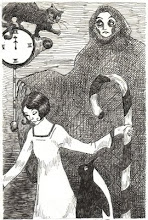
I mentioned this spread this morning, so I thought I might as well provide a picture to go with it. Puppet wears Alexander McQueen. POP. 2007.
I haven't yet found another fashion magazine that was as relentlessly creative as POP was under Katie Grand. From the same issue, a fairy wears Yves Saint Laurent below.
I've written before about how tired and sad I find the current incarnation of American Vogue, and about how I think it might be time for Mrs. Wintour to call it a day. American Vogue is mostly white washed (or appallingly racially insensitive), and filled with spread after spread of white girls leaping into the air in front of plain backgrounds. Mrs. Wintour - stop hiding Grace Coddington's light under a bushel!
Not so with Italian Vogue. This is greatly due to the latitude given to photographer Steven Meisel by editor-in-chief Franca Sozzani. Unlike in the American edition, the editors of Vogue Italia have gone to great lengths to feature a much wider variety of beautiful women than their compatriots in America.
Back in 2008 they came out with what they called the "Black Issue", featuring black models exclusively throughout the magazine - except, of course, in the advertisements, the faces in which were nearly all white, making for a telling juxtaposition. This generated a great deal of talk of steps in the right direction and of exceptionalism both. Over all, the issue was extraordinary and really showed up how narrowly beauty is still construed (Mrs. Prada, take note: I blame you for a lot of it). Also of note - the issue was a blockbuster. Particularly in the United States, it sold and sold and sold and back issues on ebay go for about $80. But, contrary to what naysayers predicted, the magazine has continued to be innovative in their art direction and choice of models, and the magazine, as a whole, is far mare integrated than the norm.
The June 2011 cover and feature spread of Vogue Italia feature what are referred to in the industry as "plus sized models". As most people with an even passing interest in the industry are aware, there has been a great deal of worry over rapidly shrinking models. Women such as Coco Rocha have spoken out about how they have been encouraged to "look anorexic". The problem is simple: models should be pretty much the same size as each other so that they can fit into the samples without much in the way of alterations. That's simple practicality. The question that no one seems to be able to answer is: why do the samples have to be so tiny? There has been a great deal of hand-wringing over the effect on young girls and their perceptions of themselves and unattainable standards. Which brings us to the world of plus size models.
Like all models, the plus sized ones are beautiful, tall and pretty much flawless. The average size is an American 10 or 12 for plus size models (but these aren't, as some of you might know, actual plus sizes), and they work mostly modeling larger sized clothes or for print advertisements for various products. Rarely will you see a plus-sized model in a mainstream fashion magazine. But this is slowly changing. Glamour Magazine has started featuring larger sized models in recent years, and a few other magazines have followed suit. And then the most maddening thing of all happened. People started hand-wringing over the fact that plus-sized models might lead young people to believe that unhealthy life-styles are okay.
This made me want to bang my head against my desk until I bled.
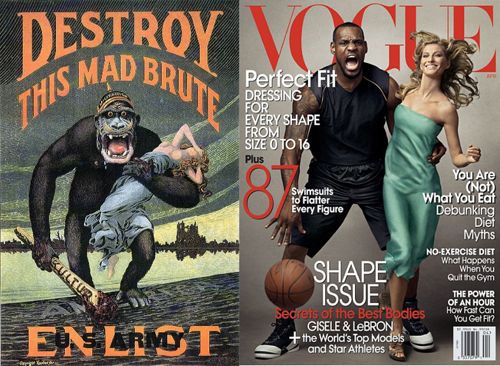
If there's one thing (well, one thing among many) I'd like to get through the world's thick, stupid head, it's that aesthetics and fashion are separate from obesity and ill-health. Plus sized models are fit and healthy (unless they have some sort of underlying health problem we don't know anything about as we don't know these people, but that goes for, like, everyone). The only realm in which these women are considered outsized is in the world of very high fashion. Because they cannot, just like all the rest of us, fit into tiny sample sizes. They are not obese, unhealthy, over-weight or anything other than professionally gorgeous. I am completely mystified how anyone could thing that the picture above left could lead any vulnerable young woman down the sad road to obesity and horror (there's much sarcasm here).
But the most upsetting thing is -the skinny women are awful because they encourage women to be anorexic. The larger models are awful because they encourage women to be fat. It's unwinnable and ghastly. Here's the truth people: Ladies, just like gentlemen, come in many shapes and sizes. Some are deemed fashionable, some are not. This is about aesthetics. Health is abut the state of one's insides, something that is unknowable from either a glance or a photograph.
Back to Steven Meisel's editorial. It's one of the sexiest I've ever seen, Meisel is a brilliant and creative photographer and the young women in the spread are gorgeous. It is telling that they are, for the most part, undressed. Katie Grand, when she was still heading up POP, managed to coerce designers into making large sizes for Beth Ditto and others, and teeny sized for marionettes in one of my favorite photo spreads ever. But she might have magic powers and I've never seen anyone else accomplish that feat (though one would think if she had the inclination la Wintour could make that happen, but, as we all know, she lacks the inclination).
Still more images of non-white women, larger sized women or (heavens!) larger sized non-white women is all to the good. Particularly with most designers not casting non-white models because they say they "don't fit in with their aesthetic" as white women are seen as unthreateningly neutral. There are always more frontiers to conquer, and one delightful mini-trend I've noticed - again in Vogue Italia, when researching this piece - is the use of older models. Forty-seven year old Kristen McMenamy graced the cover in May, and forty-one year old Stella Tennant did the same in March. Maybe things are starting to crack!
Last month, 1959 Playboy Playmate (July if you're curious) and B-movie actress Yvette Vickers was found dead in her house by a neighbor. Now, don't get the wrong idea, there was no scandal per se, she died of heart failure at the age of 82 or so. The thing is, she's been dead for nearly a year the medical examiner said, as her body was actually mummified.
Which, in a startling segue, leads me to my inamorato (the man self-styled Trav S.D.) and his performance of The Ballad of Jasper Jaxon at Dixon Place. The performance was lovely, if I do say so. Jasper Jaxon is based on real life bank robber Elmer McCurdy, who upon his death in 1911 was over-embalmed and was displayed in various traveling side-shows and theater lobbies with various purposes until it was forgotten who this fellow had been or even that he was an actual mummified person and not just a prop. Like all great true American stories it is both tragic and hilarious.
Along with her Playmate of the Month fame, Miss Vickers had a pretty impressive monster movie career. She has the typical career of small roles in big pictures (her debut was in Sunset Boulevard!) and big roles in small pictures. Most well known for her role in Attack of the 50 Foot Woman, she worked in television through the 1970s and appeared in other B horror movies, including Attack of the Giant Leeches, whose wonderful poster you can see below.
The Ballad of Jasper Jaxon is a long, rambling and extremely catchy song in the style of Woody Guthrie with definite shades of Bob Dylan. There's a certain species of Americana that seems to have fallen out of favor recently in our glittery techno present, and it's an awful shame mostly. In general, a sense of history is slowly being eroded. The internet in some ways both helps and hinders. There's such wonderful access to nearly everything, but the ease of finding whatever piece of whatever what puzzle one comes across, also serves to flatten it somewhat. The screen with which we view everything can decontextualize nearly everything until it's all just floating in a digital present.
Yvette Vickers cheerfully attended film festivals around the country in her old age. The fact that she could have disappeared for so long without anyone noticing breaks one's heart a little. The world is a lonely place for so many people, and one of my biggest fears, as it is for so many childless people, is that an end like that of Miss Vickers awaits us in the future. Both Yvette Vickers and the hapless crook Jasper Jaxon lived strange, picaresque and particularly American lives, only to wind up mummified, stuck in the parts of the newspapers designated for the weird and the uncanny, ready made to be turned, as all good American stories should be, into folk songs and B movies.
The Ballad of Jasper Jaxon will go on, no doubt and I will be sure to let you know of an recordings or return engagements.
Well, one thing. And that one thing is Five Things.
Recession blues got you down? Have you been pining to see a show with comedy, romance and a song about Nathan Fillion? Want to see a delightful show in The Brick's Comic Book Theater Festival?
The only reason she's re-entered the public's consiousness is because she is the subject of seemingly dozens of utterly charming publicity stills from the late '20s and through the '30s. I have a strong suspicion that the vast majority of those who are won over by her adorableness have never seen any of her pictures.
A few weeks ago we emerged from Cabinet Headquarters and ventured over to Film Forum where we were lucky enough to catch the rarely screened 1930 flick, Show Girl in Hollywood. As I mentioned in yesterday's post, I have a particular fondness for the early sound musicals. Show Girl, like all of them, is a backstage musical, this one based on J.P. McEvoy's novel of the same name, featuring his show girl creation, Dixie Dugan.
The novel was serialized in Liberty Magazine in 1929, and as in its comic strip spin-off, the chorus girl protagonist was modeled after that most problematic and interesting Ziegfeld alum, Miss Louise Brooks. See below:
A first, silent Dixie Dugan flick, titled simply "Show Girl" was made in 1928, also starring Alice White. Prints exist, but it's not available on either DVD or online, unfortunately. The real question is: why was Louise Brooks never even considered to play the part which was based on her? The ways of Hollywood were and are still inexplicable. Show Girl was made by First National and Brooks was signed to Paramount (though she had been loaned out to First National before), and the studio wanted to promote their own version of Clara Bow, Alice White. The picture didn't do that well (neither did Ziegfeld's stage version of 1929 starring Ruby Keeler with songs by Gershwin), but a sequel was made a couple of years later once sound was introduced.
Back to Alice White. She is, inarguably, adorable. But she's not much of an actor. She mugs and is stilted. Her singing voice is dubbed and she's a barely adequate dancer. But, as mentioned previously, she's super adorable, a trait which has launched the career of many a starlet past and present. But, adorable does not a career make and Miss White's floundered as she became enmeshed in a tabloid sex scandal (also not uncommon among starlets past and present) and her career never recovered. One way in which she does differ from many starlets is that she was a girl with a college education who began her career working behind the camera. She was Erich Von Stroheim's script girl, but he eventually fired her. She then worked for Charlie Chaplin, who first put her in front of the camera, a goal I have a feeling she may have achieved via the Chaplin casting couch.
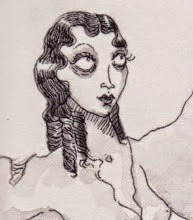
White made lots of silent comedies and then segued nicely into sound, but never really hit the big time. One can't help but wonder what the Dixie Dugan series would have been like had Louise Brooks (below right) starred. Alice White's gigantic peepers and baby-doll Brooklynese are charming enough, but Brooks had a great deal more force and charisma and was sexy as hell. And she was an actual Ziegfeld star, unlike Alice White who only performed on film.
This film itself is more interesting as historical curiosity than for its own merits. It's one of the only early talkies that shows the actual movie making process. In the film, Dixie befriends a fading silent screen star, played by Blanche Sweet, aging silent film star. Though, please mind, I use the phrase "aging" advisedly. Sweet's character is written and filmed as if she's on the verge of Norma Desmond-hood, but then she cries out with anguish, "I'm thirty-two years old!". In the screening I attended, this was not greeted by the audience with understanding and pity, but with great big gales of laughter.
As with Glorifying the American Girl, the last reel of Show Girl in Hollywood was shot in color, but in this instance all copies have been lost, and only black and white versions remain. Like in the Ziegfeld movie, there is s scene in which actual stars attend the premier of Dixie's movie. We are then treated to one of the strangest musical numbers I've ever seen (which is saying a lot, as I've seen some very strange musical numbers indeed). The song is called "Haywire" and in order to demonstrate "crazy" the filmmakers have chosen to include these bizarre dancing... figures. They look like homeless people possibly, or maybe the legendary Mole People who supposedly live below the streets of New York. It is so weird. You can see the whole sequence below:
All my caveats aside, I am beyond pleased to have gotten to see this curious picture on the big screen. And though one can't help but dream of a Brooks inhabited alternate reality version, it's a fascinating and entertaining curiosity.
We seem to be going through a phase. And by "we", I don't actually mean "me". I mean people, or really, our culture seems to be going through a phase. We seem to be going through a phase in which in order for any sort of art to be taken seriously, awful things must happen in it. Even art for children! There is death and torture and apocalypse and dystopia of all stripes. Don't get me wrong, I enjoy the gloom as much as the next person, but not, dear lord, to the exclusion of all else.
I am of the mind that qualities such as "charm" and "humor" and "good heartedness" are due for a comeback. I mean, they are certainly less plentiful than the gloomier ones, so doesn't that make them more valuable? Which brings me to Jillian Tully's play Five Things which is being presented as a part of the Brick's Comic Book Theater Festival. I saw it's premier performance yesterday afternoon and was thoroughly charmed by it.
On its surface, it's about terribly twee and simple things: a girl and her ukulele ode to Nathan Fillion, her genius, scientist cat who attempts to create a pair of opposable thumbs, a Fairy Dragmother, dates both bad and good, and tap dancing (done by the cat). But, like in Francesca Lia Block's Weetzie Bat books, the glittery surface is just a way of engaging larger ideas: those of identity and growing up and of making a real connection to other human beings. As always, in the spirit of full disclosure, Jillian is a friend, and her mode of communication is as much tap dance and pictures as it is words. The comic book aspect of the play is done through thought bubbles and signage of sound effects and wears it all lightly and well. As someone who loves comic books, but has pretty much zero interest in Superheroes, this was likely my sort of Comic Book Theater Festival show. It's very funny and sweet and well worth an hour or two of your life. There is science and romance and tap dancing. How many shows can one say that about, really?
Five Things
The Brick, 575 Metropolitan Ave. Brooklyn, NYC
There are three more performances: Sun 6/5, 6:30pm, Fri 6/10, 7pm, Sun 6/12, 6pm
Glorifying the American Girl, the 1929 film produced and supervised by Florenz Ziegfield himself, is about as close as any of us are going to get to seeing the Follies live. Which still, isn't very close.
I love the very early talkie musicals from the late twenties and very early thirties, when they were just figuring out the medium which, because of that incredible genius Busby Berkeley, got figured out pretty quickly. They're all backstage show biz tales, and that goes triple for Glorifying the American Girl. It's tells a simple story, but it's far more realistic than the ones told in Gold Diggers of 1933 or 42nd Street.
Ziegfeld star Mary Eaton plays aspiring singer and dancer Gloria Hughes who, as the film begins, works as a singer in a department store. Now, let me explain this archaic mode of employment. Gloria works behind the counter of the sheet music department, and when a customer wants to hear what a song they are interested in purchasing sounds like, she sings it, accompanied on piano by her wholesome boyfriend, Buddy. The sheet music industry at the time was huge, and deserves a post of its own for sure.
Back to Gloria. While attending a company picnic at which the management has provided variety entertainment, she meets tap dancer Miller of the vaudeville act of "Miller & Moody". After seeing her dance, he asks Gloria to become his partner. She does and goes off on tour, her avaricious harpy of a stage mother in tow. It's a grueling tour of five a day shows and one night stands - quite realistic in other words. It soon becomes clear that Miller has cycled through many, many Moodys over the years, and that he is something of a hack. A nasty, greedy piece of work, who hates other's success with a passion and expects sexual favors from his dance partners. After havong been on the road a good long while, Gloria is spotted by a Ziegfeld scout and she and Miller return to New York.
One of the things we found most exciting about this film here at Cabinet headquarters was its New York location shooting. There's a long sequence in which the streets around Grand Central are seen from driver's eye view and it's pretty amazing. I'm also pretty sure The New Amsterdam is played by The New Amsterdam. Florenz Ziegfels was at the peak of his glory when this film was shot and it shows. There's a sequence in which a crowd of luminaries are announced as the enter the theatre, including: Mayor Jimmy Walker, Noah Beery, Texas Guinan, Paramount head Adolph Zukor, and Mr. Ziegfeld himself, accompanied by his wife, Billie Burke.
We then get to watch about half an hour of a Ziegfeld spectacle. We see a long (very, very long) Eddie Cantor comedy routine, a song sung by Rudy Vallee (who I will love forever for his hilarious turn in Palm Beach Story), and Helen Morgan boozily sings a torch song from atop her piano. Make no mistake: these were the some of biggest stars alive at the time this movie was made. And there are girls. Girls and girls and more girls, wearing some of the most extraordinary costumes, and dancing and gliding across some of the most magnificent sets ever created. The Follies was both wonderful and boring. It wasn't particularly hip at the time - there were jazzier, younger, sexier and faster reviews. The Follies was an American institution, and one critic likened it to an achievement more on par with Ford's, one of automation, something to be admired, but fundamentally unsexy. In other words, it was a great deal like the sort of shows we now find in Las Vegas.
The film was written by chorus girl expert, J.P McEvoy. He was a screenwriter, short story writer and the creator of Dixie Dugan, a comic strip based on the most legendary of all chorus girls, Miss Louise Brooks. He will be featured in a post later this week. Needless to say, he knew the lay of this starry eyed though hard-bitten land well, and it shows.
And what of our heroine, Gloria? She becomes a great Ziegfeld star, of course. And in one of my favorite plot twists ever - she doesn't get the boy. Being a star is awfully time consuming, and though she weeps, no doubt everyone will be happier as things turned out. And in real life, Mary Eaton was a great Ziegfeld star, and is thus completely believable once she fufills her destiny. When Glorifying the American Girl was originally released in 1929, much of the final reel was in color, extraordinarily enough. Sadly, the versions currently available are in black and white only, and some footage was snipped post-Code because of some mild Show Girl nudity. But, all hail YouTube! Much of the color footage still exists, some of which can be seen below. Hopefully one day it will be reintegrated with the film (Martin Scorcese, are you listening, Sir?)
And what of Mary Eaton, our chorus girl heroine? From a family of show biz siblings, she is most well known today for being the sister of fellow Ziegfeld girl Doris Eaton, who became the oldest living Ziegfeld Girl prior to her death last year at the age of 106. Doris is the subject of Lauren Redniss's amazing pictorial-graphic-collage-biography, Century Girl, which is an absolutely must have for anyone with an even passing interest in Ziegfeld, chorus girls, American social history, show business, or anything at all, really. Mary was one of those complete entertainment packages that proliferated at the beginning of the last century: she could act, do light comedy, sing, tap and dance en pointe. He career wained with the fall of variety and she succumbed, like so many other talented performers both before and after, to alcoholism. She died of liver failure in 1948.
If you would like to see more of the lovely Mary Eaton, she was also featured in the early Marx Brothers film, Cocoanuts.
No, those aren't the modern skaters pictured above, but that Life Magazine snap from the '30s was so terrific I couldn't resist posting it. The Inamorato and I have been attempting to enjoy a night of vicious and exciting roller derby, as it is some by the local Gotham Girls Roller Derby. Hopefully, tonight you will be able to see Mr. S.D. and myself sitting in the stands and munching popcorn as we watch Manhattan Mayhem battle the Queens of Pain.
Tonight. 8:30. Hunter College Sportsplex. Buy tix here.
Gilda Gray was a vaudevillian, a chorus girl, a headliner in The Follies and at the Palace, and a movie star.
Now, of course, she's pretty much forgotten. Doing all this research on these former chorus girls and silent movie stars, there's one thing I'm finding particularly telling: at least half are mentioned as being "possibly the model for Norma Desmond". I picture Hollywood in the fifties being filled with strange and lovely aging goddesses who still live on cigarettes and gin. In some ways Gilda was one of them, but at heart, she was a trouper.
Born in Poland in 1901 (or thereabouts: to paraphrase Angela Carter, the birthdate of actresses is often a movable feast), her parents were killed when she was an infant, but she was luckily adopted out of the orphanage by a couple who moved with her to Milwaukee when she was 9 or 10 (or thereabouts: see above). She began her career singing and dancing in local saloons. She married when still in her early teens, had a son, got divorced and went on the road. She danced what was called (and is still called) The Shimmy. People went wild for her.
She went by a variety of names until none other than the great Sophie Tucker suggested she use the name "Gilda" because of her golden blonde hair. This was in 1919. She did, and it stuck. Gilda Gray is a far better theatrical moniker than Marianna Winchalaska, the name she was born with. She was a success in vaudeville, which led her to be hired by Florenz Ziegfeld, and in the Follies, she truly became a star. In 1923 she headed to Hollywood where she was immediately successful. Her movies were huge hits and she made lots of money, and like most true show biz success stories of the age, she was a world class workaholic.
In 1929, she lost most of her accumulated fortune in the crash, and couldn't get much movie work as her thick Polish accent was not deemed talkie friendly. So, she went back to vaudeville, where she got a booking at The Palace in New York at $3,500 a week in depression dollars. She also made some movies in England, one of which, Piccadilly, has been recently restored. I watched it a few weeks ago, and - it's not very good. In general, the English silents are pretty deadly, and this one is no exception. It's painfully slow-moving and Gilda isn't great in it. From what I gather, she was neither a great actress or a great dancer: what people came in droves to see was a pretty young woman shaking with orgasmic delight in an otherwise fairly staid world.
She had a heart attack in 1931, largely brought on by overwork. Any sort of comeback was hindered by poor health. She shot a few scenes, playing herself in The Great Ziegfeld in 1936, but her scenes were cut from the final film. She continued to perform in nightclubs when she could, got married and divorced a few times, and did some very admirable work during the war on behalf of Poland.
She died of a second heart attack in 1958, all but forgotten. The Motion Picture Relief Fund paid for her funeral.
I am a writer, director & illustrator living in Brooklyn. I have drawn many pictures, written many plays, one of which, Antarctica, has been published as a part of the Plays & Playwrights 2008 anthology. Much of my illustration and art can be viewed here: http://cavigliascabinet.tumblr.com
The vast majority of the images in this blog have been created by and are owned by me. If you would like post any of them on your site or for any other purpose, please contact me via the comments or via facebook (link to my profile is above). Thanks and enjoy.




 Posts
Posts